

How to Practice Mindfulness Without Meditation

Table of Contents
- Why Mindfulness Doesn't Require Sitting Still
- Everyday Mindfulness Exercises Without Meditation
- The Mindful Walking Exercise: Presence on the Move
- Mindful Eating Practice: Slowing Down at Meals
- Mindfulness Journaling Prompts for Daily Reflection
- A Beginner-Friendly Daily Plan to Build the Habit
- Troubleshooting Common Barriers to Mindfulness Without Meditation
- Frequently Asked Questions
Last Updated: October 17, 2026
Why Mindfulness Doesn't Require Sitting Still
You don't need a cushion, a timer, or a silent room to practice mindfulness.
Most people assume mindfulness and meditation are the same. They aren't. Meditation is a formal, usually seated and scheduled exercise; mindfulness is a way of meeting your day.
The payoff is practical: short, repeated moments of attention often fit real life better than a long sit you keep postponing.
Everyday Mindfulness Exercises Without Meditation
Everyday mindfulness exercises without meditation turn routine actions into short attention drills. Pick activities you already do, give them your full focus for a minute or two, and match the exercise to the situation you're actually in.
Paying Attention During Routine Tasks
Choose one daily task and do it with full attention. The task doesn't change; your relationship to it does.
- Brushing your teeth: Notice the brush's texture, the taste of the paste, the motion of your hand.
- Washing dishes: Feel the water's temperature and the weight of each plate.
- Folding laundry: Watch the fabric move and notice its texture under your fingers.
- Making coffee: Listen for the pour and breathe in the smell.
A common mistake is trying to do this with every task at once. Pick one. Repeat it for a week before adding another.
Using Transitions and Doorways as Cues
Doorways and transitions make excellent anchors: every time you walk through a door, take one breath and notice where you are.
Try these cues:
- Walking through a doorway
- Getting into or out of your car
- Standing up from your desk
- Waiting for your phone to unlock
These tiny pauses break the autopilot loop. They take seconds. Nobody around you will notice.
Mindfulness Exercises for Specific Situations
Generic advice fails in traffic or mid-argument. Match the practice to the moment:
- Commuting: At the first red light, feel your hands on the wheel and your back against the seat. On the train or bus, notice the floor under your feet for three breaths. Do not add music or a podcast for one leg of the trip.
- Work stress: Before opening your inbox, take one breath and notice your feet on the floor. Between meetings, stand up and feel the ground for ten seconds. When a message frustrates you, read it once without responding, then read it again.
- Conversations: Let the other person finish before you form your reply. Notice the urge to interrupt and let it pass. If you catch yourself rehearsing your response, return to their words.
- Chores: Pick one chore per day, dishes, sweeping, folding, and do it without a screen or podcast. Notice the physical sensation of the work rather than the finish line.
Troubleshooting When a Practice Fails
The exercises above break down in predictable ways. What to do when they do:
- Your mind wanders constantly. That is the practice working, not failing. Noticing the wander and returning is the rep. If you return fifty times in two minutes, you did fifty reps.
- You feel restless. Shorten the practice. Thirty seconds at a doorway counts. Restlessness often fades once the practice is small enough to finish.
- It feels pointless or silly. Keep it private and keep it short. The point is not to feel calm; it is to notice what is actually happening. Calm is a side effect, not the goal.
- You forget to do it. Attach the practice to something you already do without fail, checking your phone, starting the car, pouring coffee. The trigger already exists; you are just borrowing it.
- You have limited mobility or sensory sensitivities. Do the same attention exercise while seated, focusing on your hands, your breath, or the sounds in the room. If a sensation is uncomfortable, move to a neutral one like the weight of your body in the chair.
The Mindful Walking Exercise: Presence on the Move
The mindful walking exercise is the easiest entry point for anyone who finds sitting still difficult: walk at a slightly slower pace and place your attention on the physical feeling of each step.
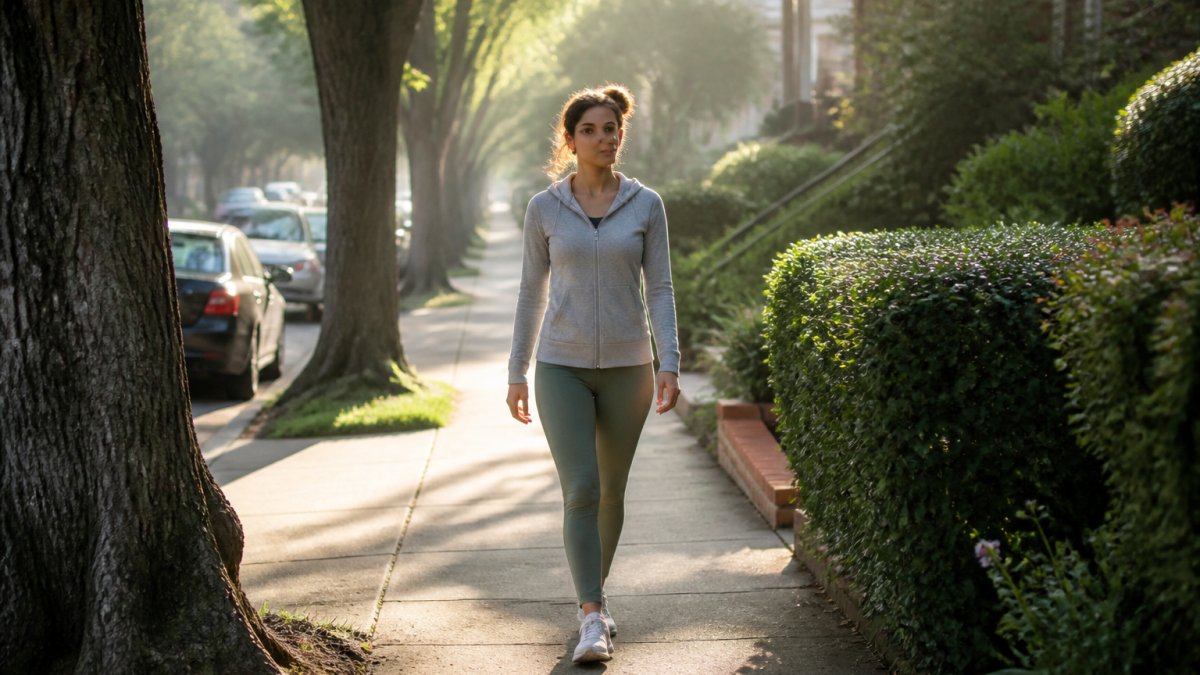
Here's how to do it:
- Walk at a comfortable, slower-than-usual pace.
- Feel your heel land, then your foot roll forward.
- Notice the shift of weight from one leg to the other.
- When your attention wanders, return it to your feet.
- Start with two minutes and build gradually.
Do it on a sidewalk, in a parking lot, or around your kitchen, no gear required. The point isn't to walk somewhere; it's to notice that you're walking.
What most guides miss: the return of attention is the exercise. The wandering isn't failure, noticing it and coming back is the rep.
Mindful Eating Practice: Slowing Down at Meals
Mindful eating practice means paying full attention to your food for the first few bites of a meal, slowing down, noticing taste and texture, and letting your body catch up with your fork.
Try this sequence at your next meal:
- Put your fork down between bites.
- Notice the color and smell before you eat.
- Chew slowly and taste what's actually there.
- Check in with your hunger halfway through.
You don't need to eat every meal this way. One meal a day, or even its first five minutes, builds the habit, and many people enjoy food more and notice fullness sooner.
Mindfulness Journaling Prompts for Daily Reflection
Mindfulness journaling prompts give your attention somewhere to land at day's end; a few written lines can turn a scattered day into a clear one.
Try one prompt per evening:
- What did I notice today that I usually rush past?
- Where did my attention go when I felt stress?
- What did I taste, hear, or feel that I'd normally ignore?
- When did I feel most present today?
- What one moment would I like to remember?
You don't need pages, two or three honest sentences count. If journaling never stuck before, start with a single prompt at a fixed time, like right before bed.
A guided journal can help here. Discover Amazing Goods offers mindfulness journals built around simple daily prompts, so you're not staring at a blank page wondering what to write.
A Beginner-Friendly Daily Plan to Build the Habit
Most guides say "start small" and leave you to figure out what small means.
| Day | Practice | Where | Time | What success looks like |
|---|---|---|---|---|
| 1 | One routine task with full attention (dishes, teeth, coffee) | Kitchen or bathroom | 1-2 min | You noticed your attention drift at least once |
| 2 | Same task, plus one doorway breath | Any doorway you use | 1-2 min + seconds | You took one breath at one door |
| 3 | Doorway breaths at every door you walk through | Home and work | Seconds each | You caught yourself at two or more doors |
| 4 | Two-minute mindful walk | Sidewalk, parking lot, hallway | 2 min | You felt heel, roll, and weight shift |
| 5 | First three bites of one meal, eaten slowly | Table or desk | 2-3 min | You tasted something you usually miss |
| 6 | One conversation with full listening | Phone call or in person | 2-3 min | You let the other person finish before responding |
| 7 | One journal prompt in the evening | Anywhere | 2-3 min | You wrote two honest sentences |
How to run each day. Pick a time you already have a routine, after breakfast, after parking, before bed.
The rule for the week: never add the next day's practice until the current one feels boring.
If you miss a day, repeat the previous day rather than skipping ahead.
How to track it without over-monitoring. A checkmark on a paper calendar is enough.
After the week, repeat it or fold the seven practices into a loose daily rhythm: one routine task, doorway breaths as they come, a short walk most days, and a prompt a few evenings a week. That's a sustainable baseline, not a program to graduate from.
Troubleshooting Common Barriers to Mindfulness Without Meditation
Barriers are normal and most have simple fixes. The most common ones:
- "I forget to do it." Attach the practice to an existing habit, like your morning coffee or your commute.
- "My mind won't stop." It doesn't need to. Noticing the thoughts and returning attention is the practice.
- "I don't have time." One minute counts. Doorway cues take seconds.
- "It feels silly." Keep it private. Nobody needs to know you're paying attention to your feet.
- "I tried before and quit." Restart with one task and one week. Smaller is better.
Accessibility matters too. If walking is difficult, do the same attention exercise seated, focusing on your hands or breathing.
Realistic outcomes help set expectations. Many people notice small shifts within a few weeks: calmer transitions, less autopilot, more enjoyment of meals.
As the American Psychological Association's guidance on mindfulness notes, mindfulness is a trainable attention skill, not a personality trait. And Harvard Health Publishing's overview of mindfulness research describes how present-moment awareness can support stress management when practiced regularly. For a broader look at how attention training fits into daily life, see the National Center for Complementary and Integrative Health.
At Discover Amazing Goods, our mindfulness journals and activity books are designed around this same idea: small, repeatable moments of attention that fit real life.
Frequently Asked Questions
Can you be mindful without meditating?
Yes. Mindfulness is the practice of paying attention to the present moment with curiosity and without judgment, and it does not require sitting meditation. You can bring present-moment awareness to everyday activities like washing dishes, walking to the car, or eating lunch. The key is noticing what you see, hear, feel, and think as it happens, then gently returning your attention when it wanders. Many people find these informal practices easier to start than formal meditation because they fit into routines you already have.
What can I do besides meditation to feel more present?
Try a few short practices woven into your day. During a mindful walking exercise, feel your feet meet the ground and notice the rhythm of your steps. At meals, take one bite slowly and observe the taste and texture as part of a mindful eating practice. Use routine transitions, like walking through a doorway or brushing your teeth, as cues to check in with your senses. Even 30 to 60 seconds of noticing your breathing or bodily sensations counts as practice and helps build the habit gradually.
How long does it take to build a mindfulness habit?
Most people notice small shifts within two to four weeks of consistent practice, though building a stable habit often takes a couple of months. Start with one or two minutes of present-moment awareness during an activity you already do daily, then build gradually. Keeping a simple log or using mindfulness journaling prompts once a week can help you track consistency without over-monitoring. If you miss a day, return to the routine without judgment, since the practice itself is about noticing and gently coming back.
What is the difference between mindfulness and meditation?
Meditation is a structured practice, usually done sitting or lying down for a set period, that trains attention through techniques like following the breath. Mindfulness is the broader skill of present-moment awareness you can apply anywhere, from listening to a coworker to washing dishes. Meditation is one way to build mindfulness, but it is not the only one. Everyday mindfulness exercises without meditation let you develop the same attention and acceptance skills during ordinary activities, which is helpful for people who find formal sitting practice difficult or unappealing.
Building a mindfulness habit without meditation comes down to one choice: start small and stay consistent. If you want a simple tool to support that habit, Discover Amazing Goods offers minimalist, eco-friendly mindfulness journals with daily prompts, plus screen-free activity books that give kids and adults a calm, focused outlet. Add to cart and start with one prompt tonight.