

Creative Ways to Practice Daily Mindfulness

Table of Contents
- Why Creative Daily Mindfulness Practices Stick
- Mindful Breathing Techniques for Present Moment Awareness
- How Long Should Mindfulness Practice Be
- Mindfulness Activities for Adults Beyond Meditation
- Mindfulness Journaling Prompts for Daily Reflection
- Integrating Mindfulness Into Daily Chores and Routines
- Overcoming Common Obstacles to Daily Practice
- Frequently Asked Questions
Last Updated: September 27, 2026
Why Creative Daily Mindfulness Practices Stick
People abandon mindfulness not from lack of commitment but from boredom. When practice feels like obligation, you stop showing up. Creative ways to practice daily mindfulness change this by engaging you through activities you already enjoy: coloring, journaling, breathing exercises, even washing dishes.
The right tools can transform mindfulness from a chore into something people want to do. When your practice matches your personality and lifestyle, you stick with it. A person who loves art will color for 20 minutes daily; someone who processes emotions through writing will journal consistently.
Mindfulness is the practice of bringing present moment awareness to daily activities without judgment. It's not about clearing your mind or achieving a perfect meditative state. It's about noticing what's happening right now: sensations in your body, sounds around you, the taste of your coffee. That shift in attention reduces stress and builds emotional regulation.
These creative practices work because they're woven into moments you already experience. You're not adding another task; you're transforming existing activities into mindfulness practice. That's what makes these practices sustainable.
Mindful Breathing Techniques for Present Moment Awareness
Your breath is always available and the fastest anchor to the present moment. Breathing techniques form the foundation of mindfulness practice and require nothing but a few minutes and your awareness.
Box Breathing for Stress Reduction
Box breathing uses four equal counts that form a square: inhale for 4, hold for 4, exhale for 4, hold for 4. This pattern activates your parasympathetic nervous system, signaling safety and calm.
Here's how to practice it:
- Sit or lie in a comfortable position
- Inhale through your nose for a count of 4
- Hold your breath for a count of 4
- Exhale through your mouth for a count of 4
- Hold empty for a count of 4
- Repeat for 5-10 cycles
The symmetry matters. Your nervous system responds to the predictable rhythm. Most people feel noticeably calmer after just three rounds. Use this when stress spikes, before difficult conversations, or as a daily grounding technique.
4-7-8 Breathing for Grounding
This technique emphasizes the exhale, which naturally relaxes your body. Inhale for 4, hold for 7, exhale for 8.
Steps to practice:
- Sit upright with your back supported
- Inhale through your nose for a count of 4
- Hold that breath for a count of 7
- Exhale slowly through your mouth for a count of 8
- Pause briefly, then repeat
- Complete 4-8 cycles
The extended exhale is key. Your body can't stay in fight-or-flight mode during a long, controlled exhale. Use this in the evening to wind down or whenever your mind races.
How Long Should Mindfulness Practice Be
Consistency matters more than duration. A 5-minute daily practice beats a 30-minute weekly one. If you're managing anxiety, 10-15 minutes daily is ideal. If you're building focus, 15-20 minutes helps. If you're starting out or have a packed schedule, 5 minutes is enough.
Research shows that people who meditated for just 10 minutes daily showed measurable improvements in attention and emotional regulation within two weeks. Duration matters less than regularity.
Start with whatever time you'll actually commit to.
Mindfulness Activities for Adults Beyond Meditation
Meditation is only one way to practice daily mindfulness. For many adults, structured sitting practice feels artificial or boring. Creative activities deliver the same benefits: reduced stress, improved focus, present moment awareness, and emotional regulation.
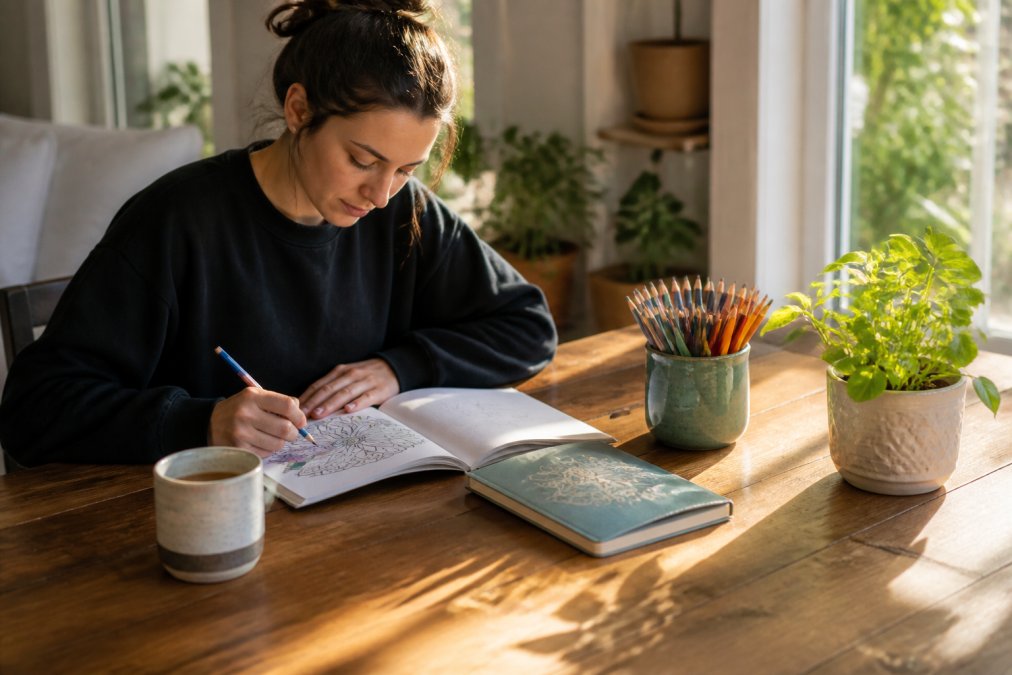
Mindful Coloring and Creative Expression
Coloring engages your brain in a way that quiets the default mode network, the part of your mind that generates worry and rumination. You focus on the immediate task: choosing colors, staying within lines, observing patterns. That focused attention creates a meditative state.
- Choose a coloring book with patterns that appeal to you
- Gather your coloring tools
- Find a quiet space with good lighting
- Take three deep breaths before starting
- Begin coloring, noticing the texture of the pencil, the colors you choose, the movement of your hand
- If your mind wanders, gently return focus to the colors and patterns
- Continue for 15-30 minutes
Tactile Mindfulness Through Hands-On Creation
Your hands are powerful grounding tools. Sculpting with clay, molding with Play-Doh, working with textiles, or building with blocks activate tactile awareness and present moment focus.
Steps for tactile mindfulness practice:
- Gather a hands-on material (clay, Play-Doh, textiles, or craft supplies)
- Sit comfortably at a table or on the floor
- Close your eyes for 10 seconds and set an intention
- Open your eyes and begin working with the material
- Notice the temperature, texture, and resistance
- Observe your impulses without judgment
- Continue for 20-30 minutes
- Pause and notice how you feel
Mindfulness Journaling Prompts for Daily Reflection
Journaling transforms mindfulness from isolation into self-understanding. Writing slows your thinking, makes internal experience visible, and creates a record of growth.
Gratitude and Observation Prompts
Gratitude journaling rewires your brain toward noticing what's working. Specific observation prompts create real presence:
- What's one small thing you noticed today that you usually overlook?
- What did you taste today that you actually paid attention to?
- Who made you feel seen or heard today, and how did that feel in your body?
- What's one thing that went right today, and what specifically did you do to make it happen?
- What sensory experience did you enjoy today?
Sensory Grounding Through Writing
This practice anchors you in your five senses, one of the fastest ways to interrupt anxiety and return to the present moment.
Try this exercise:
- Sit comfortably and set a timer for 10 minutes
- Notice and write down:
- 5 things you can see
- 4 things you can physically feel
- 3 things you can hear
- 2 things you can smell
- 1 thing you can taste
- Write descriptively: instead of "soft blanket," write "the weight of the wool blanket against my legs, warm and slightly scratchy"
- Notice how your nervous system feels different after this practice
Integrating Mindfulness Into Daily Chores and Routines
The most sustainable mindfulness practice is one you don't schedule separately. When you bring intentionality to activities you're already doing, mindfulness becomes woven into daily life instead of another obligation.
Mindful Walking and Movement
Walking is meditation in motion. Most people walk on autopilot, thinking about their destination or to-do list. Mindful walking brings present moment awareness to the movement itself.
Here's how to practice mindful walking:
- Choose a route you know well
- Before you start, pause and notice your breath
- Begin walking at a natural pace
- Focus on physical sensations: feet contacting the ground, legs moving, arms swinging
- Notice your surroundings: what do you see, hear, smell?
- If your mind wanders, gently return attention to the physical experience of walking
- Walk for 10-20 minutes
Eating and Drinking With Intention
Mindful eating transforms a routine activity into a sensory and emotional practice. Instead of eating while distracted, you notice flavors, textures, and your body's signals.
Steps for mindful eating:
- Choose one meal or snack to practice with
- Before eating, pause and notice your hunger level
- Observe the food: colors, aromas, textures
- Take the first bite and chew slowly (aim for 20-30 chews before swallowing)
- Notice flavors, textures, and how your body responds
- Continue eating at this pace for the entire meal
- Pause halfway through and check your fullness level
- Finish when you feel satisfied
| Practice | Duration | Best Time | Key Benefit |
|---|---|---|---|
| Box breathing | 2-5 minutes | When stressed | Immediate calm |
| Mindful coloring | 15-30 minutes | Morning or evening | Focus and relaxation |
| Sensory grounding | 5-10 minutes | Anytime | Anxiety relief |
| Mindful walking | 10-20 minutes | Daily routine | Attention span |
| Mindful eating | One meal daily | Lunch or dinner | Body awareness |
Overcoming Common Obstacles to Daily Practice
The biggest obstacle to daily mindfulness isn't finding the right technique. It's maintaining consistency when life gets busy, when you don't see immediate results, or when you forget your practice exists.
Frequently Asked Questions
What are some fun ways to practice daily mindfulness?
Creative approaches make mindfulness more engaging. Try mindful coloring to focus on patterns and colors, use journaling prompts to reflect on your day, practice intentional breathing during routine activities, or engage in tactile activities like molding clay. The key is choosing methods that match your interests, visual learners benefit from coloring, reflective types thrive with journaling, and kinesthetic learners prefer hands-on activities. Mixing methods prevents boredom and deepens your practice.
How long should mindfulness practice be for beginners?
Start with 5-10 minutes daily. Research shows that short, consistent sessions build habit formation better than occasional longer practices. A quick breathing exercise during your morning coffee or five minutes of journaling before bed establishes routine without feeling overwhelming. As your practice deepens, gradually extend to 15-20 minutes. The most important factor is consistency, a 5-minute daily practice outperforms sporadic 30-minute sessions in developing sustained attention and emotional regulation.
Can mindfulness be practiced through creative hobbies?
Absolutely. Creative activities like coloring, crafting, or journaling engage the same present-moment awareness as formal meditation. When you focus fully on patterns, colors, or words without judgment, you activate the same cognitive focus and stress reduction that mindfulness cultivates. The tactile feedback from creative work also enhances sensory grounding, making it an effective tool for building mental fitness. Choose activities that naturally draw your attention, that's where mindfulness happens.
What makes mindfulness journaling different from regular journaling?
Mindfulness journaling uses intentional prompts to anchor your attention on present-moment sensations, emotions, and observations rather than just recording events. Prompts like 'What five things do I notice right now?' or 'How does my body feel?' shift focus from past or future to the here and now. This non-judgmental observation builds self-compassion and psychological well-being. Guided journaling also creates accountability and habit formation, the structured prompts make it easier to start and sustain the practice daily.