

How to Teach Mindfulness to Kids: A 2026 Guide

Table of Contents
- What Mindfulness for Kids Actually Looks Like
- How to Practice Mindfulness with Toddlers
- Mindfulness Activities for Kids at Home and in the Classroom
- Guided Meditation Scripts for Children
- Mindfulness Tools for Kids That Actually Get Used
- Teaching Mindfulness to Neurodivergent Kids
- Troubleshooting Resistance: When Kids Refuse to Participate
- Modeling Mindfulness: Why Your Own Practice Matters
- Frequently Asked Questions
Last Updated: September 1, 2026
What Mindfulness for Kids Actually Looks Like
Mindfulness for kids is the practice of helping children direct their attention to the present moment, what they see, hear, feel, and sense right now, without judging it as good or bad. It's not sitting still in silence for twenty minutes. Kids take to mindfulness fastest when it looks like play: a breathing game, a sensory scavenger hunt, a short guided story.
According to the Child Mind Institute's guidance on mindfulness for children, even brief, structured mindfulness practices can help kids build focus, manage frustration, and recover from emotional disruption more quickly. The benefits compound over time, but the first session doesn't need to be perfect.
Below, we'll walk through how to teach mindfulness to kids at every stage, from toddlers to tweens, including scripts, activities, tools, and what to do when your kid flat-out refuses.
Why Emotional Regulation Starts Here
Emotional regulation is the ability to recognize, manage, and respond to emotions in ways that serve you. Mindfulness builds the neural pathways that support it.
When a child pauses to notice what they're feeling in their body, tight chest, fast heartbeat, clenched fists, they create a small gap between stimulus and reaction. That gap is where impulse control lives. Schools that integrate mindfulness into classroom management report calmer transitions and fewer behavioral disruptions. The goal is not to eliminate big emotions, but to give kids a toolkit for working with them.
How to Practice Mindfulness with Toddlers
Children ages 2-4 are naturally present-moment focused. The task isn't to teach them a new skill; it's to name what they're already doing and build on it. Sessions should last no more than 2-3 minutes and should feel like games.
A few approaches that work well at this age:
- Belly breathing with a stuffed animal: Have the child lie down and place a small toy on their stomach. Ask them to make the toy "go up and go down" with their breath.
- Sound listening: Ring a bell or tap a glass and ask, "Can you hear it until it's completely gone?" This builds sustained attention in under a minute.
- Texture touch: Pass around objects with different textures, smooth, rough, soft, bumpy, and ask the child to describe what they feel.
Sensory Awareness Games for Ages 2-4
Sensory awareness is the gateway to mindfulness for very young children. Their cognitive development is dominated by sensory input, which means activities that engage touch, smell, sight, and hearing land far more effectively than verbal instruction.
Try these:
- Smell jars: Fill small containers with familiar scents, cinnamon, lavender, lemon. Ask the child to close their eyes and guess what they smell.
- Quiet walking: Walk through a room as slowly and quietly as possible. Ask the child to count how many sounds they can hear.
- Cloud watching: Lie on the grass and describe cloud shapes together. This builds the habit of observation without agenda.
Mindfulness Activities for Kids at Home and in the Classroom
The biggest mistake parents and teachers make is treating mindfulness as a separate subject rather than weaving it into existing routines: morning circle time, transitions after lunch, the five minutes before bed.
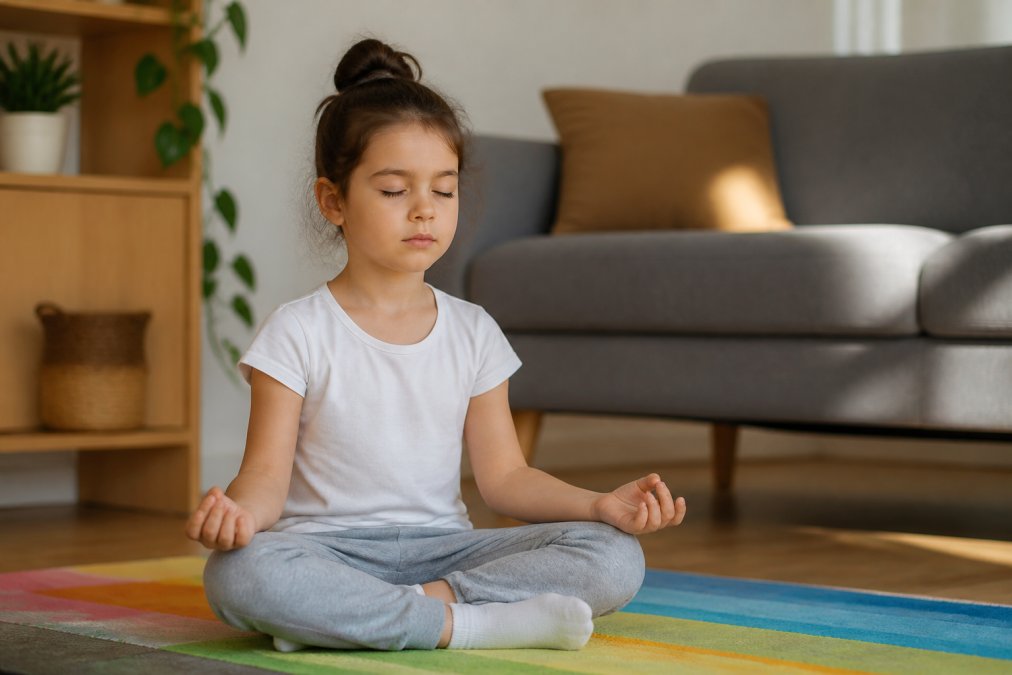
At home:
- Mindful eating: Ask your child to describe one thing they taste, smell, and feel before taking a second bite.
- Gratitude check-in: Three things they noticed today, not just "good things," but anything they actually paid attention to.
- Bedtime body scan: Starting from toes, ask the child to notice each part of their body and let it relax. Takes 3-4 minutes and improves sleep quality.
In the classroom:
- Breathing anchor: Teach students to press their feet flat on the floor and take three slow breaths before a test or transition.
- Mindful minute: One minute of silence at the start of class where students focus only on their breath.
- Emotion weather report: Ask students to describe their current emotional state as weather, "I'm feeling stormy," "I'm sunny today."
Mindful Breathing and Body Scan Exercises
Mindful breathing is the single most transferable skill in a child's mindfulness toolkit. It works anywhere, requires no equipment, and produces immediate results for stress management.
Teach children the 4-7-8 pattern: inhale for 4 counts, hold for 7, exhale for 8. For younger children, simplify it to "breathe in like you're smelling flowers, breathe out like you're blowing out birthday candles."
Body scan exercises extend this awareness through the whole body. Guide the child to close their eyes and notice each body part in sequence, feet, legs, stomach, chest, shoulders, arms, hands, neck, face. Ask them to notice any tension without trying to fix it.
The Five Senses Grounding Exercise
The five senses exercise is one of the most effective grounding techniques for children experiencing anxiety or overwhelm. It redirects attention from internal distress to external sensory input.
The sequence:
- 5 things you can see, name them out loud
- 4 things you can touch, reach out and feel them
- 3 things you can hear, listen carefully
- 2 things you can smell, take a breath
- 1 thing you can taste, notice it
This exercise works for ages 5 and up and takes about 90 seconds. It's particularly effective as a calm-down strategy before a meltdown escalates.
Guided Meditation Scripts for Children
Guided imagery is the most accessible form of meditation for children because it meets them where they are: in their imagination. According to the Greater Good Science Center at UC Berkeley's research on mindfulness for youth, guided meditation practices adapted for children can support emotional intelligence and reduce anxiety when practiced consistently.
Keep scripts short. For ages 5-7, aim for 3 minutes. For ages 8-12, 5-7 minutes is appropriate. Always use present-tense, sensory-rich language.
A 5-Minute Guided Imagery Script for Ages 5-10
Read this slowly, with pauses after each sentence:
Close your eyes and take a slow breath in... and breathe out.
Imagine you're walking through a quiet forest. The ground is soft under your feet. You can hear birds somewhere above you.
You find a sunny clearing and sit down on the warm grass. Notice how the sun feels on your face. Notice the sounds around you.
If a thought comes into your mind, imagine it's a leaf floating down a stream. Watch it drift away. Then come back to the clearing.
Take three slow breaths. Each time you breathe out, feel yourself sink a little deeper into the grass.
When you're ready, wiggle your fingers and toes. Take one more breath. Open your eyes.
Mindfulness Tools for Kids That Actually Get Used
The mindfulness tools for kids that actually get consistent use share three qualities: they're tactile, they require no setup, and they can be used independently once introduced.
Here's what tends to stick:
- Breathing cards: Laminated cards with visual breathing guides that the child traces with their finger.
- Calm-down kits: A small box with sensory items, a smooth stone, fabric, a squeeze ball.
- Mindfulness journals: Structured prompts work far better than blank pages. Prompts like "draw how your body feels right now" give the child a starting point.
- Sand timers: A visual timer for breathing exercises removes the adult from the equation.
- Activity books: Coloring, dot-to-dot, and pattern activities create a focused, meditative state without requiring the child to "try to be mindful."
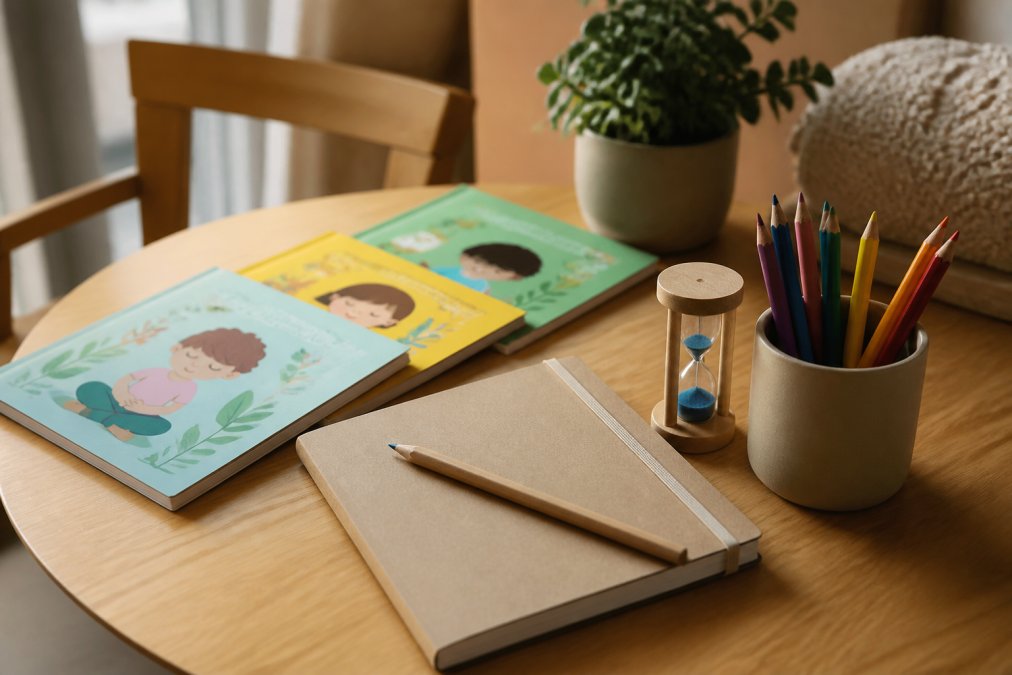
Discover Amazing Goods offers a curated selection of activity books and mindfulness journals designed specifically for this purpose, screen-free, tactile, and structured to hold a child's attention. Customers like Jessica M. have noted that kids become "obsessed" with the activity books, which is exactly the kind of engagement that makes mindfulness a habit rather than a chore.
Teaching Mindfulness to Neurodivergent Kids
Standard mindfulness instructions often fail neurodivergent children, not because mindfulness doesn't work for them, but because the delivery is wrong.
For children with ADHD, the instruction to "sit still and focus on your breath" is neurologically counterproductive. Movement-based mindfulness works far better: mindful walking, yoga poses, or bouncing on a trampoline while counting breaths.
For children on the autism spectrum, sensory sensitivities require careful consideration. Start with external sensory anchors, a smooth object to hold, a specific sound to listen for, before moving to internal body awareness.
According to the Autism Science Foundation's resources on sensory and behavioral support, individualized approaches that account for sensory profiles produce significantly better outcomes than one-size-fits-all interventions.
Practical adaptations for neurodivergent children:
| Child's Profile | Recommended Approach | What to Avoid |
|---|---|---|
| ADHD | Movement-based mindfulness, short bursts (1-2 min) | Long seated practices |
| Autism spectrum | External sensory anchors, predictable routines | Unexpected changes to practice format |
| Anxiety | Five senses grounding, breathing cards | Open-ended "notice everything" instructions |
| Sensory processing differences | Tactile tools, visual timers | Auditory-only instructions |
Troubleshooting Resistance: When Kids Refuse to Participate
Resistance is the most common obstacle parents and teachers report, and it's usually misread. Kids don't refuse mindfulness because they don't need it. They refuse because the approach doesn't match their developmental stage, personality, or current emotional state.
"This is boring." The activity is too passive or abstract. Fix: add movement, sensory elements, or a game structure. A child who won't sit for a body scan might happily do a "robot vs. noodle" game where they alternate tensing and releasing their muscles.
"I can't do it." The child is experiencing performance anxiety. Fix: make it explicit that there is no wrong way. "We're just noticing, not doing it right."
"I don't want to." The child associates mindfulness with being in trouble. Fix: introduce mindfulness during neutral, positive moments, not only during meltdowns.
Refusal from older kids (ages 10+). Adolescents often resist anything that feels childish or imposed. Fix: frame it differently. "This is the same technique athletes use before competitions" lands better than "Let's do our mindfulness practice."
Consistency matters more than perfection. The first few sessions are really about building trust in the practice.
Modeling Mindfulness: Why Your Own Practice Matters
If you're teaching mindfulness to kids but you're not practicing it yourself, you're working at a significant disadvantage. Children learn emotional regulation primarily through co-regulation, watching how the adults around them handle stress, frustration, and uncertainty.
The most effective thing you can do for a child's mindfulness practice is establish even a minimal practice of your own: five minutes in the morning, a breathing exercise during your commute, a brief body scan before sleep.
A few practical ways to model mindfulness:
- Narrate your own practice out loud: "I'm feeling frustrated right now, so I'm going to take a few slow breaths."
- Practice alongside the child rather than directing from outside.
- Acknowledge when you forget or skip your practice; this normalizes imperfection.
As documented in Harvard's Center on the Developing Child research on co-regulation, the adult-child co-regulation relationship is foundational to a child's capacity to develop self-regulation. Mindfulness modeled by a calm, present adult is more powerful than any script or tool.
The most important thing is to start. One breathing exercise, one sensory game, one guided story. Kids don't need a perfect mindfulness program. They need a consistent, caring adult who shows them what it looks like to pause before reacting.
Many parents and educators find it hard to know where to start when it comes to teaching mindfulness to kids. Discover Amazing Goods offers a curated selection of children's activity books and mindfulness journals designed to make that first step concrete and accessible. Our eco-friendly, screen-free books give kids a tactile, engaging way to build focus and self-awareness without requiring a formal curriculum or a perfectly quiet room. Browse the collection and add to cart the tools that fit your child's world.
Frequently Asked Questions
What are the benefits of teaching mindfulness to kids?
Regular mindfulness practice builds emotional regulation, impulse control, and sustained attention in children. Kids who practice consistently tend to handle stress better, show stronger self-awareness, and recover from emotional upsets faster. These skills support cognitive development and classroom behavior. Even short daily sessions of two to five minutes can help children develop the mental clarity and calm-down strategies they carry into adulthood.
How long should a mindfulness session be for different age groups?
A good rule of thumb is one minute per year of age. Toddlers aged two to three do best with one to two minutes of sensory awareness play. Children aged four to seven can sustain three to five minutes of guided breathing or body scan exercises. Kids aged eight and older can handle five to ten minutes of structured mindfulness, including guided meditation scripts for children or mindful listening activities. Always end before attention fades.
How can I introduce mindfulness to a child who struggles to sit still?
Movement-based mindfulness works best for kids who resist sitting. Try mindful walking, where they name what they feel under their feet with each step, or a slow-motion stretching routine paired with deep belly breathing. Grounding techniques like the five senses exercise can be done standing. For neurodivergent children, shorter bursts of two minutes with a visual timer reduce resistance and build positive reinforcement around the practice over time.
What are some simple mindfulness exercises for kids to do at home?
Three exercises work well for home use: intentional breathing with a stuffed animal on the belly, the five senses exercise where kids name five things they see, four they hear, three they can touch, two they smell, and one they taste, and a short body scan at bedtime. Mindfulness activities for kids are most effective when they become part of a routine, such as after school or before sleep, rather than used only during moments of stress.