

Best Educational Activity Books for Toddlers

Table of Contents
- Quick Comparison: Top Educational Activity Books for Toddlers
- Learning Activity Books for 2-Year-Olds
- Educational Activity Books for 3-Year-Olds
- Screen-Free Activities for Toddlers: Why Activity Books Matter
- Fine Motor Activities for Toddlers: Building Skills Through Play
- What Makes a Good Educational Activity Book for Toddlers
- How to Choose the Right Activity Book for Your Toddler's Age
- Conclusion
- Frequently Asked Questions
Last Updated: October 12, 2026
Quick Comparison: Top Educational Activity Books for Toddlers
Finding the right educational activity books for toddlers can feel overwhelming. At Discover Amazing Goods, we offer a curated selection designed to engage toddlers while developing critical early learning skills.
The best educational activity books combine hands-on activities with age-appropriate learning goals. Toddlers learn through play, and the right book makes the difference between a shelf decoration and one your child reaches for repeatedly.
Quick Picks:
- Best Overall: Discover Amazing Goods Educational Activity Books, ideal balance of minimalist design and multi-activity engagement for most toddlers
- Best Budget Option: Dover Little Activity Books, pocket-sized, affordable, perfect for travel and on-the-go learning
- Best for Preschoolers: Scholastic Preschool Learning Activity Books, structured early learning with counting and letter focus for ages 3-6
Below, we'll break down the top options by age, highlight what makes each special, and show you how to pick the right fit for your child's developmental stage.
Learning Activity Books for 2-Year-Olds
Two-year-olds are in a transition zone. Many can turn board-book pages, peel a large sticker with help, and scribble with a fat crayon, but their pincer grasp is still developing and attention runs in short bursts. The right activity book meets them at that stage.
What developmental readiness looks like at this age
- Grasp: Most 2-year-olds use a whole-hand or fisted grip on crayons. Look for chunky crayons and pages with wide, open shapes rather than detailed line work.
- Page turning: Board pages and thick cardstock survive enthusiastic turning better than thin paper. Spiral-bound books lie flat, which helps a toddler who hasn't mastered holding a page down while working.
- Attention: A realistic window is often 5-10 minutes per activity, sometimes less. Books that change activity type every page or two hold attention better than long runs of the same task.
- Sticker handling: Large, easy-peel stickers with a visible edge are manageable. Tiny stickers are both frustrating and a choking hazard.
Safety and materials to check before buying
Small parts are the main concern at this age. Stickers, magnets, and removable pieces should be large enough that they can't fit entirely inside a cardboard toilet-paper tube, the common household proxy for a choking-hazard test.
Formats that work at this stage
- Sticker books with large pieces: Good for pincer-grasp practice, but expect adult help peeling at first.
- Reusable dry-erase or wipe-clean books: Laminated pages let a toddler scribble, wipe, and repeat. They cost more per book but can replace several consumable ones.
- Felt or fabric quiet books: No loose paper to tear, and pieces attach with hook-and-loop or snaps. These tend to be the most durable option for car rides and restaurants.
- Simple coloring and tracing books: Best with very large shapes and thick outlines.
What to skip
Skip books with intricate mazes, small dot-to-dot puzzles, or pages that require reading instructions. Skip anything with tiny stickers or loose parts unless you plan to supervise closely.
A practical approach: buy one inexpensive sticker or coloring book first, watch which pages your toddler returns to, then invest in a reusable format once you know their preference.
Educational Activity Books for 3-Year-Olds
Three-year-olds are usually ready for more deliberate mark-making, simple letter and number exposure, and multi-step tasks, but the range within this age is wide.
Skills that activity books can support at this age
- Pincer grasp and hand strength: Stickers, peel-and-place activities, and tracing build the same thumb-and-finger control used for holding a pencil.
- Hand-eye coordination: Dot-to-dot, simple mazes, and coloring within outlines practice aiming and stopping at a target.
- Early literacy: Letter recognition, matching uppercase to lowercase, and tracing letter shapes introduce the idea that symbols carry meaning. This is exposure, not reading instruction.
- Early numeracy: Counting objects, matching numerals to quantities, and simple patterns lay groundwork for later math.
- Problem-solving: Two- or three-step puzzles, sequencing, and 'what comes next' activities encourage planning.
Safety and supervision
At 3, most children have moved past mouthing objects, but small parts still matter.
Format trade-offs
| Format | Best for | Watch out for |
|---|---|---|
| Consumable workbook | One-time use, low upfront cost | Adds up if your child finishes quickly |
| Reusable dry-erase book | Repeated practice, travel | Requires dry-erase markers; pages can smudge |
| Sticker book | Fine motor practice, high engagement | Stickers are single-use; small pieces are a hazard |
| Fabric quiet book | Durability, quiet settings | Higher upfront cost; fewer pages |
| Mixed-activity book | Variety, longer engagement | Quality varies widely; check page thickness |
How to judge difficulty progression
A well-built book for this age starts with large, simple tasks and gradually adds detail.
Budget and value
Consumable workbooks often run in the low single digits to around ten dollars, while reusable dry-erase and fabric quiet books cost more upfront but can be used many times.
Screen-free use cases
Activity books are especially useful where screens are impractical: car rides, restaurant waits, waiting rooms, and quiet time at home.
A reasonable next step: pick one format that matches your child's current skills and one that stretches them slightly. Rotating between the two keeps frustration low while building new abilities.
Screen-Free Activities for Toddlers: Why Activity Books Matter
Screen time dominates early childhood, but hands-on, screen-free play builds stronger cognitive and motor development. Activity books offer a concrete alternative parents can feel good about.
When toddlers engage with activity books, they practice focus without the passive stimulation of screens, making choices about colors, solving simple problems, and controlling their own pace. These experiences build neural pathways that support later academic skills.
Beyond skill development, activity books create quiet time many parents need. A toddler absorbed in one gives caregivers a window to handle household tasks or simply sit together in calm focus, strengthening the parent-child relationship in ways screens can't replicate.
The best screen-free activity books are ones your toddler will actually choose, so variety matters. If your child gravitates toward stickers, stock sticker activities; if they love drawing, prioritize coloring and tracing books. The goal is making screen-free play more appealing than asking for a device.
Fine Motor Activities for Toddlers: Building Skills Through Play
Fine motor skills are the foundation for writing, drawing, and self-care tasks like buttoning and zipping. Activity books build them naturally through play, without formal instruction.
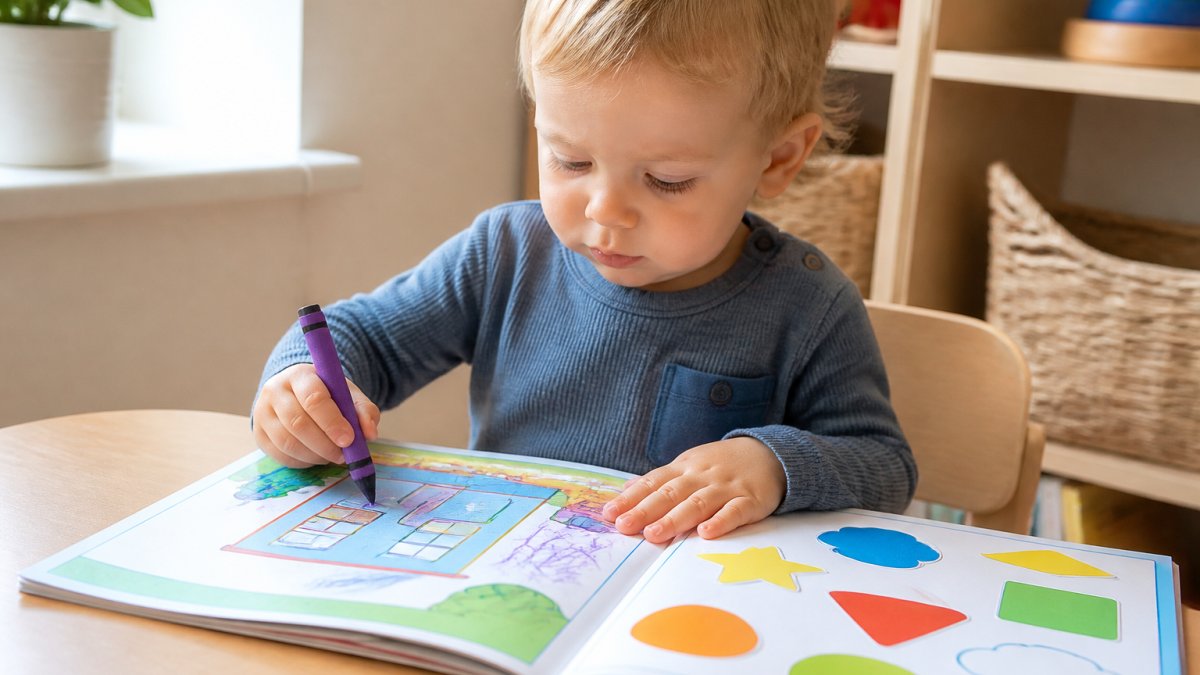
Sticker activities are particularly effective: peeling requires the pincer grasp, which directly transfers to pencil control. Tracing builds hand strength and coordination, while coloring within large shapes teaches spatial awareness and hand-eye coordination.
Discover Amazing Goods activity books emphasize these fine motor-building activities. When a toddler has fun with stickers or tracing, they build motor control without realizing they're practicing.
Progression matters. Look for books that start with large, simple tasks and gradually add detail; one that jumps straight to intricate mazes will frustrate a toddler who needs simpler challenges first. Quality educational activity books scaffold difficulty, meeting your child where they are.
What Makes a Good Educational Activity Book for Toddlers
A truly educational activity book balances engagement with developmental appropriateness, materials quality, and design clarity.
First, look for books that combine multiple activity types.
Second, consider design philosophy. Minimalist design reduces visual overwhelm and helps toddlers focus, while busy, cluttered pages compete for attention and reduce focus time. The best educational activity books for toddlers use clear layouts, simple illustrations, and plenty of white space.
Third, examine materials. Thick pages resist tearing, durable covers survive a diaper bag, and water-resistant or laminated pages allow reusable dry-erase activities. These features determine whether a book lasts weeks or months.
Finally, check whether activities actually teach something. Letter recognition, number awareness, shape identification, color sorting, and problem-solving should all appear naturally throughout the book. The best educational activity books teach without feeling like lessons.
| Feature | Why It Matters | What to Look For |
|---|---|---|
| Multiple activity types | Prevents boredom, maintains engagement | Stickers, coloring, tracing, matching, mazes |
| Age-appropriate difficulty | Builds confidence, prevents frustration | Clear progression from simple to slightly complex |
| Durable materials | Survives toddler wear and tear | Thick pages, reinforced binding, quality paper |
| Minimalist design | Reduces overwhelm, improves focus | Clear layouts, simple illustrations, white space |
| Educational content | Builds skills naturally | Letters, numbers, shapes, colors, problem-solving |
How to Choose the Right Activity Book for Your Toddler's Age
Age matters, but individual development varies widely. Some 2-year-olds have the focus for activities designed for 3-year-olds, while some 3-year-olds prefer simpler tasks.
For 18-24 months, stick with books featuring large stickers, simple matching, and bright colors. Activities should take less than a minute to complete. Attention span is short, so variety is essential.
For 2-3 years, introduce books with slightly more complex tasks. Stickers still work, but add simple tracing, basic coloring, and matching games. Activities can stretch to 2-3 minutes.
For 3-4 years, educational activity books can include letter and number recognition, more detailed mazes, and counting activities. Your child can now focus for 15-20 minutes if genuinely interested.
Consider personality too. Some toddlers will spend 30 minutes on a sticker book; others get frustrated with stickers and prefer coloring or tracing. The right activity book matches both age and preference.
Conclusion
Educational activity books for toddlers work because they combine learning with play in a format that builds fine motor skills, focus, and early academic awareness. The best options balance minimalist design with multi-activity engagement, offering enough variety to hold attention while teaching something meaningful.
At Discover Amazing Goods, we offer activity books for parents who want screen-free alternatives. Our curated collection features minimalist, eco-friendly designs that reduce visual overwhelm while building skills through hands-on play. Each book combines stickers, coloring, dot-to-dot, and matching, so your toddler stays engaged across different learning challenges.
Start with one book that matches your child's age and interests. Watch what captures their attention, then build your collection based on what holds their focus. The right educational activity book becomes something your child reaches for repeatedly, not a shelf decoration.
Frequently Asked Questions
What skills can toddlers practice with educational activity books?
Educational activity books help toddlers develop fine motor skills through drawing, coloring, and tracing. They also build hand-eye coordination, concentration, and problem-solving abilities. Activities like matching, sorting, and simple puzzles introduce early learning concepts such as colors, shapes, numbers, and letters. These hands-on experiences support cognitive development while keeping toddlers engaged in screen-free play.
Are activity books suitable for toddlers who are still learning to use crayons?
Yes, activity books are ideal for toddlers developing crayon control. Start with books featuring larger spaces and thicker lines, which are easier for developing hands to manage. Dot-to-dot activities, coloring pages, and sticker activities require less precision than detailed drawings. As your toddler's fine motor skills improve, gradually introduce books with smaller spaces and more complex activities. Look for books designed specifically for younger toddlers, which account for developing hand strength and coordination.
How do I choose an activity book that is right for my toddler?
Consider your toddler's age, developmental stage, and interests. Books for 2-year-olds typically feature simple activities like stickers and large coloring areas, while 3-year-olds can handle more complex tasks like mazes and matching. Look for books with engaging themes your child enjoys, such as animals, vehicles, or dinosaurs. Check that pages are durable and materials are safe. Eco-friendly, minimalist designs often use high-quality paper and non-toxic inks. Reading customer reviews can confirm whether the book holds a toddler's attention and matches your expectations.
How can I make activity-book time engaging without screens?
Create a dedicated, distraction-free space for activity-book time with good lighting and comfortable seating. Keep a small selection of books available so your toddler can choose. Sit nearby to offer encouragement and gentle guidance without taking over. Make it social by doing activities together, talking about what you're creating, and celebrating completed pages. Rotate books regularly to maintain novelty and interest. Combine activity books with other screen-free activities like building blocks or outdoor play to create a balanced day of hands-on learning and creativity.
Ready to build a screen-free activity collection for your toddler? Explore Discover Amazing Goods's curated selection of educational activity books designed to inspire learning, creativity, and focused play. Find the perfect book for your child's age and developmental stage today.