

Best Mindfulness Books for Toddlers 2026: Top Picks

Table of Contents
- How We Chose the Best Mindfulness Books for Toddlers
- 1. Breathe Like a Bear: Best for Quick Calm-Down Strategies
- 2. I Am Peace: Best for Building Emotional Vocabulary
- 3. My Magic Breath: Best Interactive Mindfulness for Toddlers
- 4. In My Heart: A Top Emotional Regulation Book for Toddlers
- 5. Alphabreaths: Best for Learning Letters and Mindful Breathing
- How to Teach Mindfulness to Kids with These Books
- Simple Mindfulness Activities for Toddlers to Try Today
- Frequently Asked Questions
Last Updated: September 9, 2026
Mindfulness books for toddlers build the emotional regulation skills that carry children through tantrums, transitions, and bedtime resistance. Finding the best mindfulness books for toddlers 2026 means looking past pretty illustrations to titles that actually hold a two-year-old's attention long enough to teach a breathing exercise or a feelings lesson.
Quick Picks:
- Best Overall for Calm: Breathe Like a Bear, 30 short exercises that fit any routine
- Best for Feelings: In My Heart, builds emotional vocabulary with a die-cut design
- Best for Interactive Kids: My Magic Breath, turns breathing into a game
- Best for Early Learning: Alphabreaths, pairs the ABCs with mindful breathing
How We Chose the Best Mindfulness Books for Toddlers
A mindfulness book only works if a toddler stays engaged past page three. We evaluated each title against three criteria: short exercises for a toddler's attention span, concrete rather than abstract language, and usability without elaborate preparation. We prioritized books that support emotional regulation and calm down strategies rather than just telling a story about being calm.
Most guides miss a key point: the best mindfulness books for toddlers are the ones that give parents a script. When you are mid-meltdown, you do not want to improvise. You want a phrase like "smell the flower, blow out the candle" that you and your child already know from the book. Research on early childhood social-emotional learning consistently shows that repetition and predictability help young children internalize coping skills Zero to Three's guidance on toddler emotional development.
1. Breathe Like a Bear: Best for Quick Calm-Down Strategies
Breathe Like a Bear earns the top spot because it gives you 30 distinct mindfulness exercises in one volume, each designed to take under a minute. The movements are simple enough for a three-year-old to follow, and the book organizes them by need, so you can flip to a "calm down" exercise during a tantrum or a "focus" exercise before dinner.
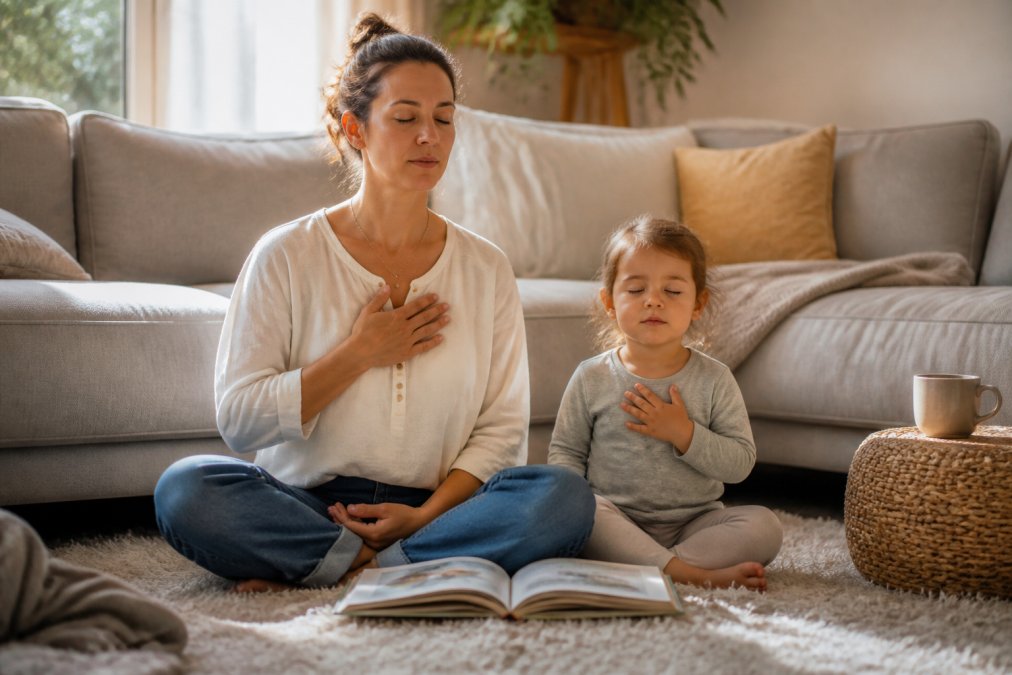
What makes this title stand out is its versatility across transitions, bedtime routines, and moments of high energy. The one drawback is that younger toddlers, around two years old, need an adult to demonstrate each movement before they can join in.
2. I Am Peace: Best for Building Emotional Vocabulary
I Am Peace: A Book of Mindfulness takes a gentler, story-driven approach to teaching children how to connect with their surroundings and find inner peace. The book's language is deliberately calming, and the illustrations support a sense of quiet and safety. For parents focused on building emotional vocabulary, this title introduces words like "peace," "calm," and "present" in a way toddlers can absorb.
The book ends with a guided meditation, giving parents a ready-made script for a wind-down activity. Where it falls short is length; some two-year-olds lose interest before the final pages. For children closer to four, though, this book builds empathy and self-compassion naturally rather than instructionally.
3. My Magic Breath: Best Interactive Mindfulness for Toddlers
My Magic Breath turns mindful breathing into an interactive game, which is exactly what many toddlers need. Rather than listening to instructions, children actively participate by breathing in and out along with the story, using their breath to "blow away" worries or "gather" happy thoughts. The interactive prompts require active parent involvement, but that is precisely the point: this book creates a shared moment of co-regulation between parent and child.
The focus here is on the physical sensation of breathing, which helps toddlers develop sensory awareness and grounding techniques. For children who struggle to sit still for stories, the participatory format keeps them engaged. The book teaches a concrete tool for anxiety management and stress reduction that children can carry into preschool and beyond.
4. In My Heart: A Top Emotional Regulation Book for Toddlers
In My Heart: A Book of Feelings is less about breathing and more about helping toddlers name what they feel, a foundational step in emotional regulation. The book explores a wide spectrum of emotions, from happiness to sadness to bravery, and each page features a die-cut heart that grows and changes with the feeling. The visual design is genuinely engaging, and the text gives parents the emotional vocabulary to talk through big feelings.
This is the book to reach for when your toddler is frustrated, angry, or overwhelmed but cannot explain why. Reading it together creates a safe framework for discussing feelings, which builds emotional intelligence over time. The tradeoff is that it does not teach specific breathing or calming techniques; it focuses on identification and validation. For emotional regulation books for toddlers, that identification step is often the missing piece parents need most.
5. Alphabreaths: Best for Learning Letters and Mindful Breathing
Alphabreaths cleverly combines literacy with mindfulness by pairing each letter of the alphabet with a simple breathing exercise. "A" becomes "Alligator Breath," where children open their arms wide like an alligator's mouth and snap them shut while exhaling. For toddlers learning their letters, this book turns mindful breathing into a daily practice that also builds pre-reading skills.
The repetitive, rhythmic cues make the exercises easy to memorize, so children can practice them away from the book. The main limitation is that some letter-based breaths feel abstract for very young toddlers; the "X" exercise requires more imagination than a two-year-old may have. For children aged three and up, though, this is an exceptional tool for combining focus and attention span development with early literacy.
How to Teach Mindfulness to Kids with These Books
Knowing how to teach mindfulness to kids with books is about timing, consistency, and having a script. Top parenting resources from organizations like Child Mind Institute and Zero to Three emphasize that toddlers learn emotional regulation through co-regulation, you stay calm so they can borrow your calm. Here is a practical, three-phase framework that turns any of the books above into a tool you will actually use mid-meltdown.
Phase 1: Prime the Pump (During Calm Moments)
Read the book when your child is regulated, after breakfast or before nap, so the language becomes familiar. Do not just read the words; act them out. If you are reading Breathe Like a Bear, get on the floor and do the "Bear Breath" with exaggerated movements. Your toddler needs to see your belly expand and hear your exhale to mirror it. Toddlers need at least five exposures to a new coping phrase before they can retrieve it under stress (peer-reviewed research).
Phase 2: The Mid-Meltdown Script (When It Counts)
This is where most guides stop short. The real skill is deploying the book's language when your child is dysregulated. Keep the book within arm's reach in the living room or car. When you see frustration building, do not say "Calm down", that is abstract. Instead, use a concrete, familiar cue from the book:
- From Breathe Like a Bear: "Let's do the whale breath together. Watch my hands go up... and down."
- From My Magic Breath: "Can you blow your mad thoughts away like the boy in the book? Show me your big blow."
- From In My Heart: "Your heart feels like the stormy page right now. Let's find the sunny page together."
This scripted approach works because it pairs a physical action with a narrative your child already knows. You are not improvising; you are retrieving a stored memory of calm.
Phase 3: The Debrief (After the Storm)
Once your child is regulated, which can take 10 to 20 minutes after a full meltdown, return to the book briefly. Point to the page you used and say, "You did the whale breath. That helped your body feel better." This labeling builds the neural pathway for self-awareness. For neurodivergent-friendly mindfulness, skip the verbal debrief entirely; a thumbs-up or a high-five is enough.
A Note on Timing
A common mistake is reading these books only during calm moments. The real power comes from using them when your child is already upset. Keep a book like Breathe Like a Bear within reach, and when you see frustration building, say "Let's read the bear breath page together." This teaches your child that books are tools for feeling better, not just quiet-time activities. For toddlers under three, keep the session to one page or one exercise.
Post-Reading Reflection Questions
After finishing a mindfulness book, ask your toddler simple questions to reinforce the lesson. Keep these questions concrete and brief:
- "What did your body feel like when you took a big breath?"
- "Can you show me where you feel happy in your body?"
- "What should we do next time you feel really mad?"
- "Which animal breath was your favorite? Why?"
These questions build emotional vocabulary and help your child connect the story to their own sensory awareness. For neurodivergent-friendly mindfulness, adapt the questions to your child's communication style; pointing, nodding, or showing a feeling face are all valid answers. If your child cannot answer verbally, model the answer yourself.
Simple Mindfulness Activities for Toddlers to Try Today
You do not need a dedicated meditation corner to practice mindfulness activities for toddlers. Start with one activity and repeat it daily for a week. The goal is not mastery; it is creating a shared ritual of calm. Focus on activities that engage the senses your toddler actually uses to learn: touch, sound, and movement.
Sensory-Based Mindfulness: The Underserved Angle
Most mindfulness lists for toddlers ignore a core developmental truth: toddlers are sensory learners. Their brains process the world through touch, taste, and proprioception (body position) long before abstract language. Sensory-based mindfulness activities are not just engaging, they are neurologically appropriate. Here are activities that pair well with the books above and lean into tactile learning.
-
Texture Breathing: Place a small piece of textured fabric (velvet, corduroy, or a soft wool scrap) in your child's hand. Instruct them to rub the fabric slowly while taking three deep breaths. The tactile input anchors the breath to a physical sensation, which is easier for a toddler to replicate than an abstract instruction like "breathe deep." This is particularly effective for children with sensory processing differences who may find visual-guided breathing overwhelming.
-
The Weighted Blanket Squeeze: After reading Breathe Like a Bear, have your toddler lie on their back. Place a small, weighted lap pad (or a firm couch cushion) on their torso. Ask them to breathe in and push the weight up with their belly, then breathe out and let it sink. The proprioceptive input from the weight provides deep pressure that calms the nervous system, a technique used by pediatric occupational therapists for emotional regulation (aota.org).
-
Sound Jar Meditation: Fill a clear jar with water and glitter glue. Shake it and ask your toddler to watch the glitter swirl while taking slow breaths until it settles. This visual anchor is a concrete representation of the mind settling. For toddlers who are auditory learners, replace the jar with a singing bowl and ask them to raise their hand when they can no longer hear the ring.
Movement-Based Mindfulness for High-Energy Toddlers
Some toddlers cannot sit still for a breathing exercise, and that is okay. Mindfulness for this age group can be fully embodied. Pediatric yoga instructors often recommend pairing movement with breath to build interoception (the sense of what is happening inside your body).
-
Animal Yoga Poses: Pair a book like Alphabreaths with simple yoga poses. "Alligator Breath" becomes a full-body stretch: lie on the belly, push up on the hands, and open the mouth wide on the inhale, snap it shut on the exhale. "Butterfly Breath" becomes seated butterfly pose with slow wing flaps. The key is to narrate the breath, not just the pose: "Open your wings on the in-breath. Close them slow on the out-breath."
-
The Freeze Game with a Twist: Play a classic freeze dance, but instead of freezing the body, freeze the breath. When the music stops, say "Freeze your breath!" and model holding your breath for two seconds, then release. This teaches impulse control and breath awareness simultaneously.
A Weekly Rhythm That Works
Most practitioners find that a predictable weekly rhythm beats daily improvisation. Here is a sample structure that pairs each day with a different sensory modality:
- Monday (Touch): Texture breathing with a fabric square.
- Tuesday (Sound): Sound jar or singing bowl practice.
- Wednesday (Movement): Animal yoga from Alphabreaths.
- Thursday (Sight): Read My Magic Breath and practice "blowing worries" into a real pinwheel.
- Friday (Proprioception): Weighted blanket squeeze with Breathe Like a Bear.
This rotation keeps novelty high, which toddlers crave, while building a consistent routine. For families seeking screen-free entertainment that builds resilience and inner peace, pairing mindfulness books with sensory-based activities creates a foundation that lasts well beyond the toddler years.
Frequently Asked Questions
What is the best mindfulness book for toddlers in 2026?
The best mindfulness books for toddlers in 2026 focus on simple, actionable techniques. Breathe Like a Bear is a top choice for its 30 short exercises, while My Magic Breath excels at interactive participation. For building emotional awareness, I Am Peace and In My Heart are excellent. The right pick depends on your child's age and whether they need help with calming down, focusing, or naming their feelings.
How can I teach mindfulness to my toddler using books?
Start by reading the book when your child is already calm, not during a meltdown. Use the book's prompts as a playful game. For example, with Breathe Like a Bear, you can pretend to blow out birthday candles. Keep sessions short, about 5 minutes, and repeat the same book often. Your enthusiasm is key; if you practice the breathing and movements with them, they are more likely to follow along and learn the skill.
Are there specific mindfulness books for toddlers with anxiety?
Yes, several books are designed to help toddlers manage worry. Ruby Finds a Worry is a gentle story that normalizes anxiety and encourages children to talk about their feelings. Books that teach concrete breathing techniques, like My Magic Breath, give toddlers a physical tool they can use when they feel overwhelmed. Look for stories with a calm, reassuring narrative and a character who successfully manages a big emotion.
How do I choose the right mindfulness book for a 2-year-old?
For a 2-year-old, prioritize durable board books with simple, rhythmic text, like Bunny Breaths. Look for books that focus on one or two basic actions, such as breathing or noticing the body. At this age, visual appeal is important, so choose books with large, clear illustrations. Avoid text-heavy guides. The goal is to model calm behavior and introduce the concept of a 'quiet time' rather than expecting them to master any technique.