

Best Screen Free Gifts for Children: 8 Top Picks for 2026

Table of Contents
- Quick Comparison: Best Screen Free Gifts for Children
- How We Evaluated These Screen Free Gifts
- 1. Discover Amazing Goods Activity Books: Best for Creative Focus
- 2. LEGO Medium Creative Build Box: Best for Open-Ended Building
- 3. Melissa & Doug Slice & Bake Cookie Set: Best for Imaginative Play
- 4. Stomp Rocket Ultra: Best for Active Outdoor Fun
- 5. Slackers NinjaLine Intro Kit: Best for Physical Challenge
- 6. Yoto Player: Best for Independent Audio Entertainment
- What About Screen-Free Play for Neurodivergent Kids?
- How to Encourage Creativity in Children With These Gifts
- Benefits of Screen-Free Play
- Frequently Asked Questions
Last Updated: September 16, 2026
Quick Comparison: Best Screen Free Gifts for Children
Finding the best screen free gifts for children starts with what actually holds a kid's attention without a glowing rectangle. This guide from Discover Amazing Goods cuts through the noise with eight tested picks, ranked by developmental value, durability, and replayability.
Quick Picks:
- Best Overall: Discover Amazing Goods Activity Books
- Best for Building: LEGO Medium Creative Build Box, 484 pieces of open-ended play
- Best for Active Kids: Stomp Rocket Ultra, physics-based outdoor fun
- Best for Independent Play: Yoto Player, screen-free audio entertainment
| Product | Starting Price | Best For | Ages |
|---|---|---|---|
| Discover Amazing Goods Activity Books | Varies | Creative focus | 3+ |
| LEGO Medium Creative Build Box | $34.99 | Open-ended building | 4+ |
| Melissa & Doug Slice & Bake Cookie Set | $27.99 | Imaginative play | 3+ |
| Stomp Rocket Ultra | $19.99 | Active outdoor fun | 6+ |
| Slackers NinjaLine Intro Kit | $99.99 | Physical challenge | 5+ |
| Yoto Player | $99.99 | Independent audio | 3+ |
A common mistake is buying for the age on the box instead of the child's play style. A builder who ignores stuffed animals will ignore a plush toy no matter how many awards it won.
How We Evaluated These Screen Free Gifts
Every pick was scored against five criteria: developmental benefit, durability under real kid handling, replay value after the novelty fades, independence of play, and value relative to cost.
We prioritized items that build fine motor skills, spatial reasoning, or social-emotional growth. Toys that only entertain for a week got cut.
American Academy of Pediatrics guidance on screen time and child development
1. Discover Amazing Goods Activity Books: Best for Creative Focus
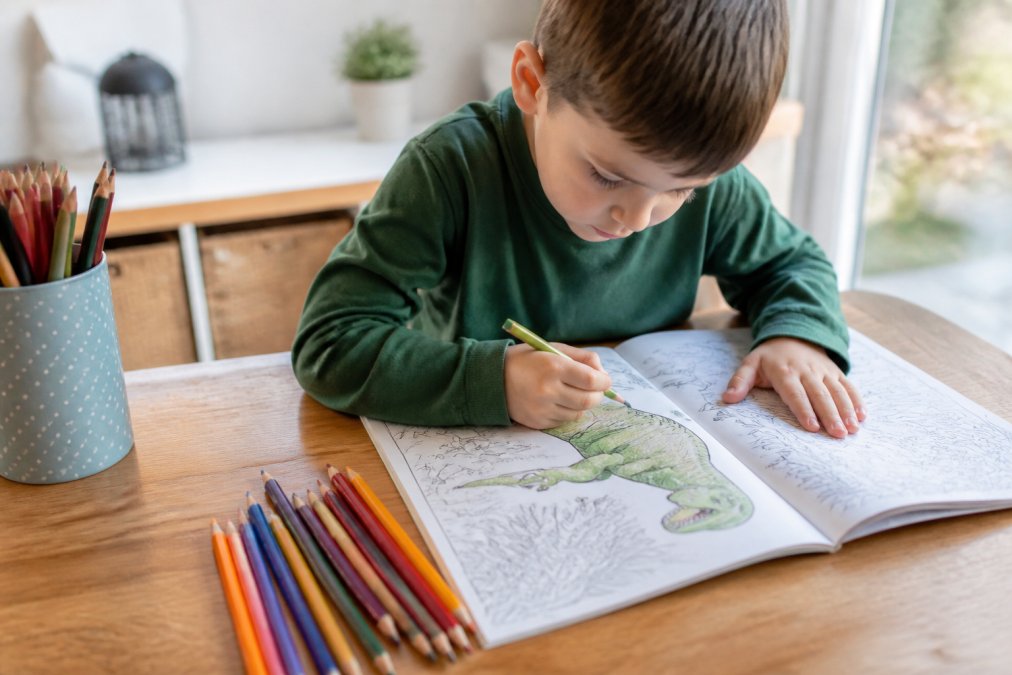
Activity books are the quiet workhorses of screen-free play. They build fine motor skills, focus, and number recognition through color-by-number, dot-to-dot, and coloring pages, and work anywhere a flat surface exists.
Discover Amazing Goods offers a curated collection of children's activity books with minimalist, eco-friendly designs. The dinosaur and insect titles are popular choices.
Pros and Cons
Pros:
- Combines multiple activities in one book (color-by-number, dot-to-dot, coloring)
- Minimalist designs that don't overwhelm younger kids
- Portable and mess-free for travel
Cons:
- Consumable, kids finish them and want more
- Not ideal for children who need gross motor movement
2. LEGO Medium Creative Build Box: Best for Open-Ended Building
Open-ended construction sets are the gold standard for independent play. The LEGO Medium Creative Build Box packs 484 pieces in 35 colors, plus windows, doors, and wheels, into a sturdy storage box.
Unlike themed kits, there's no instruction manual telling kids what to build. That forces child-led discovery, which is why the set stays interesting for years instead of weeks, while spatial reasoning and problem-solving develop through trial and error.
The one drawback is organization. Small pieces scatter fast, and the included box only helps if kids actually use it.
3. Melissa & Doug Slice & Bake Cookie Set: Best for Imaginative Play
Pretend play sets build social-emotional growth. The Melissa & Doug Slice & Bake Cookie Set includes 12 sliceable wooden cookies, 12 toppings, a wooden knife, spatula, and cookie sheet.
The self-stick tabs that hold the cookies together make this work: kids slice, "bake," and decorate without adult direction, and the durable wood survives being dropped, sat on, and chewed.
The limitation is scope. This is a kitchen toy, and kids who don't gravitate toward cooking scenarios will lose interest quickly.
4. Stomp Rocket Ultra: Best for Active Outdoor Fun
The Stomp Rocket Ultra delivers active play with zero batteries. Kids stomp on the launch pad, air pressure does the rest, and foam-tipped rockets fly; the adjustable launch angle lets them experiment with flight paths.
Setup takes under two minutes.
5. Slackers NinjaLine Intro Kit: Best for Physical Challenge
Gross motor development needs equipment that scales with a kid's growing strength. The Slackers NinjaLine Intro Kit runs a 36-foot slackline between two trees with seven hanging obstacles, and the distance between obstacles adjusts as skills improve.
6. Yoto Player: Best for Independent Audio Entertainment
Screen-free audio is the sleeper category here. The Yoto Player uses physical cards kids insert to play stories, music, and podcasts, with a built-in night light and alarm clock; parental controls through the app manage volume and content.
What About Screen-Free Play for Neurodivergent Kids?
Most screen-free gift guides treat neurodivergent children as an afterthought. That is a mistake: the features that make a toy work for an autistic, ADHD, or sensory-seeking child, predictable feedback, low demand, no flashing lights or sudden sounds, tend to make it better for every child. A toy that overwhelms a sensory-sensitive kid usually overwhelms everyone else within a week.
What to look for
- Silent or near-silent operation. No electronic beeps, no volume to negotiate.
- Predictable cause and effect.
- A defined end point. Activity books with color-by-number and dot-to-dot pages give a child a visible finish line. For kids who struggle with unstructured time, "three more numbers and this page is done" is easier to start than "go play."
- Heavy work and movement. The Slackers NinjaLine Intro Kit and the Stomp Rocket Ultra both deliver proprioceptive input, the deep pressure and resistance feedback that many sensory-seeking kids crave. Stomping on a launch pad is a legitimate regulation tool disguised as a toy.
- Low-demand entry. Construction sets with no instruction manual, like the LEGO Medium Creative Build Box, remove the pressure of following steps in order. A child can sort, stack, or build one wall and still be playing correctly.
What to skip
American Academy of Pediatrics guidance on screen time and child development
How to Encourage Creativity in Children With These Gifts
The best screen free gifts for children only work if the environment supports them. A few practical moves separate a toy that gets used from one that collects dust.
- Create a dedicated play zone with low shelves so kids can reach their own supplies
- Rotate toys monthly instead of keeping everything out at once
- Store activity books and art supplies together in one grab-and-go bin
- Keep a travel kit packed with one activity book for outings
- Model the behavior: sit down and color alongside your child without your phone nearby
Match the gift to the age, not just the interest
Most guides sort by age and stop there. The more useful filter is age and play style: a four-year-old builder and a four-year-old storyteller need different gifts even though the box says the same number.
Add a play prompt, not just a product
A gift gets more use when it arrives with an idea attached. Tape a short "how to play" card to the box: three building challenges for a construction set, three story starters for a pretend-play kit, three obstacle-course layouts for a ninja line. The prompt gives the child a low-effort way to begin and signals that this gift is meant to be played with, at least the first time.
Benefits of Screen-Free Play
The benefits of screen-free play show up in measurable ways: stronger fine motor control from handling small pieces, improved sustained attention from activities that require patience, and better social skills from collaborative play.
Frequently Asked Questions
What are the benefits of screen-free play for child development?
Screen-free play builds critical thinking, problem-solving skills, and social-emotional growth through hands-on learning. When children engage in open-ended play, they develop fine motor skills and spatial reasoning. Physical toys like building sets and art supplies also encourage creative expression and independent play, which are essential for developmental milestones.
How can I encourage creativity in children without using electronics?
Offer open-ended materials like art supplies, building blocks, and pretend play sets. Create a dedicated space for messy play and display their work. Rotate toys to keep engagement high. When you participate in child-led discovery, you show that creative expression is valued, which encourages them to explore without needing a screen.
What are some good screen-free gifts for a child who gets bored easily?
Look for gifts with high replayability, such as building sets with many pieces or an audio player like the Yoto Player that offers new stories. These options provide varied, engaging experiences that can adapt to different moods and interests, helping to maintain focus and reduce screen-time reduction.
How do minimalist toys for kids improve focus and imagination?
Minimalist toys for kids reduce overstimulation by offering fewer, higher-quality options. This simplicity encourages deeper engagement and longer periods of independent play. Without a flood of flashing lights and sounds, children rely on their own imagination to drive the play, which strengthens cognitive development and problem-solving skills.
What is the 5 gift rule for kids and how does it reduce screen reliance?
The 5 gift rule suggests giving one item from each category: something they want, something they need, something to wear, something to read, and something to share. This framework naturally prioritizes meaningful, often screen-free gifts like books and collaborative games, reducing the volume of digital devices and encouraging active, imaginative play.