

How to Teach Mindfulness to Children: A Step-by-Step Guide

Table of Contents
- What Mindfulness for Children Actually Means
- Why Teaching Mindfulness to Children Matters
- Mindfulness Activities for Kids That Actually Work
- How to Practice Mindfulness with Toddlers
- Using Mindfulness Journals for Kids
- Emotional Regulation Strategies for Kids
- Building a Daily Mindfulness Routine
- Troubleshooting Common Resistance and Challenges
- Frequently Asked Questions
Last Updated: September 22, 2026
What Mindfulness for Children Actually Means
Mindfulness for children teaches kids to focus on the present moment without judgment, noticing their breath, feelings, and surroundings rather than worrying about the past or future.
Children today face constant distractions from screens, schedules, and stress. Learning how to teach mindfulness to children gives them a tool to pause, notice emotions, and respond instead of react.
Mindfulness activities paired with creative outlets, like activity books, make the practice feel like play rather than a chore, helping kids develop self-awareness and emotional intelligence.
Mindfulness isn't traditional meditation. Even two minutes of focused breathing counts. The goal is building awareness, not perfection.
Why Teaching Mindfulness to Children Matters
Children who practice mindfulness develop stronger emotional regulation skills, learning to notice emotions and pause before reacting, reducing conflict, improving focus, and building resilience.
Research shows mindfulness reduces stress and anxiety, improves attention and concentration, builds emotional intelligence, decreases impulsive behavior, and strengthens the ability to calm down. Regular practice strengthens neural pathways that support focus and emotional control.
Every child benefits from mindfulness, confident kids stay grounded, shy kids build social courage, and energetic kids channel their intensity.
Mindfulness Activities for Kids That Actually Work
Different children respond to different approaches. The key is trying various activities and noticing what works.
Breathing Exercises for Calm and Focus
Intentional breathing is the foundation of mindfulness, it calms the nervous system immediately and requires no equipment.
The 4-Count Breath works for most kids ages 4 and up:
- Breathe in for 4 counts
- Hold for 4 counts
- Breathe out for 4 counts
- Pause for 4 counts
- Repeat 5 times
The Balloon Breath appeals to younger children:
- Pretend to blow up a balloon slowly (breathe in)
- Hold the balloon (hold breath)
- Let the air out slowly (breathe out)
The Smell the Flower, Blow Out the Candle technique combines two breaths:
- Breathe in slowly through the nose (smelling a flower)
- Breathe out slowly through the mouth (blowing out a candle)
- Repeat 5-10 times
Body Scan and Sensory Grounding
A body scan teaches kids to notice physical sensations without judgment, building present-moment awareness.
The 5-Minute Body Scan:
- Lie down or sit comfortably
- Close eyes (optional, some kids prefer eyes open)
- Start at the top of the head and mentally move down the body
- At each area, ask: "What do I feel here? Warm? Cold? Tense? Relaxed?"
- Don't try to change anything, just notice
Keep body scans to 2-3 minutes for younger children.
Sensory Grounding for Anxious Moments: When a child feels overwhelmed, use the 5 Senses technique:
- Name 5 things you see
- Name 4 things you can touch
- Name 3 things you hear
- Name 2 things you smell
- Name 1 thing you taste
This grounds kids in the present moment and interrupts anxiety spirals through active attention.
Mindful Listening and Present Moment Awareness
Mindful listening teaches kids to focus fully on what they hear, building concentration and strengthening relationships.
The Sound Meditation:
- Sit quietly for 2-3 minutes
- Listen to all the sounds around you
- Don't label them as good or bad, just notice them
- Notice the sounds fade in and fade out
The Conversation Practice: Teach kids to listen without planning their response. During family meals:
- One person speaks while others listen
- Listeners focus completely on the speaker
- No interrupting, no planning what to say next
- Then switch roles
How to Practice Mindfulness with Toddlers
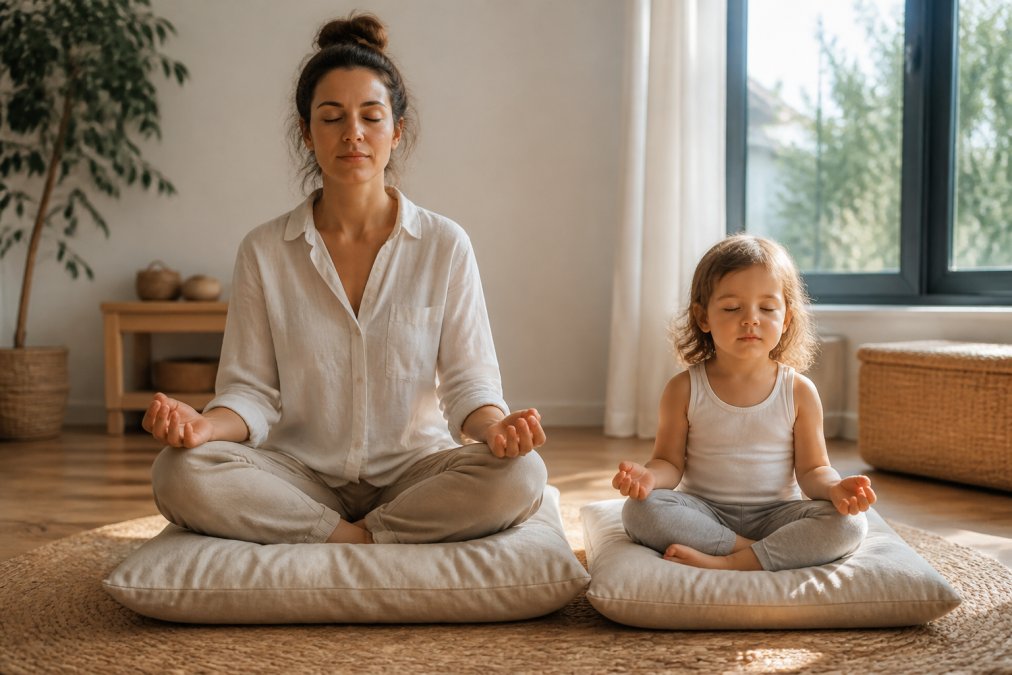
Mindfulness for toddlers (ages 2-4) means brief, playful moments embedded in daily life rather than formal seated practice.
Core Principles for Toddler Mindfulness
Keep it under 2 minutes. Two minutes of intentional breathing beats 10 minutes of frustrated struggle.
Make it sensory-rich. Toddlers learn through touch, sight, sound, and movement:
- Touch: Pass around a smooth stone, soft blanket, or textured toy and narrate what you notice ("This is cold and smooth")
- Sight: Watch bubbles float, leaves blow, or light dance on a wall
- Sound: Listen to a singing bowl, bell, or wind chimes; name the sounds together ("That's a ding")
- Smell: Smell flowers, herbs, or fruit; keep it simple ("This smells like apple")
- Movement: Stomp and freeze, stretch like a cat, stand tall like a tree, sway like seaweed
Use songs and rhythm. Toddlers respond to music and repetition, sing slow breathing songs, pair breathing with movement, or use nursery rhymes as anchors.
Model it yourself. Kids copy what they see.
Digital Mindfulness for Toddlers: A Unique Angle
Rather than eliminating screens, teach intentional screen use through mindfulness.
Mindful screen time (5-10 minutes, 2-3 times per week):
- Guided breathing apps: Apps like Breathwiser or Cosmic Kids Yoga offer 2-3 minute guided breathing videos for toddlers
- Nature videos: Play 3-5 minute nature documentaries and practice "watching meditation" together
- Music and movement: Use YouTube videos of slow, intentional movement like Cosmic Kids Yoga
- Interactive apps: Apps like Headspace for Kids or Calm offer toddler-specific guided meditations
Playful Mindfulness Activities for Toddlers
The Bubble Watch (1-2 minutes): Blow bubbles slowly and watch them together, building visual focus and present-moment awareness.
What NOT to Do with Toddlers
Don't force sitting still. Mindfulness in motion counts.
Don't use complex language. Use simple words: "Feel," "Listen," "Watch," "Notice."
Building a Toddler Mindfulness Routine
Consistency matters, but it doesn't have to be formal:
| Time | Activity | Duration |
|---|---|---|
| Morning | Slow breathing while getting dressed | 1 minute |
| Midday | Sensory play (textures, sounds, or bubbles) | 2-3 minutes |
| Afternoon | Slow walk or nature observation | 3-5 minutes |
| Evening | Calm-down activity before bed (soft music, gentle rocking) | 3-5 minutes |
Pick one or two activities and rotate. The goal is weaving mindfulness into existing routines, not adding another task.
Using Mindfulness Journals for Kids
Mindfulness journals combine mindfulness with creative expression, helping kids process feelings, track emotional growth, and build fine motor skills while making mindfulness feel like play.
Simple Journal Prompts:
- "Today I felt calm when..."
- "One thing I noticed today was..."
- "My body felt [tense/relaxed/energetic] when..."
- "I'm grateful for..."
- "When I felt upset, I..."
Emotional Regulation Strategies for Kids
Teaching mindfulness to children improves emotional regulation by helping kids recognize emotions early and respond with intention.
Building a Daily Mindfulness Routine
Consistency matters more than intensity.
Morning Routine (2 minutes): Three intentional breaths and one small intention.
| Routine | Duration | Best Time | What to Do |
|---|---|---|---|
| Morning | 2 min | After waking | Breathing + intention |
| Midday | 1-2 min | Before lunch | Pause + reset |
| Evening | 3-5 min | Before bed | Body scan + gratitude |
Troubleshooting Common Resistance and Challenges
Understanding resistance and having scripts ready helps you address it without power struggles.
Resistance Scripts That Work
When a child says "I can't sit still":
Offer choices: walking meditation, mindful movement, fidget-friendly mindfulness, or standing meditation. Giving control back to the child drops resistance dramatically.
When a child says "This is boring":
Neurodivergent-Specific Adaptations
Standard mindfulness guidance often fails for children with ADHD or autism. These adaptations address their neurological differences:
For Children with ADHD:
For Children with Autism:
When a Child Refuses Entirely
If a child refuses, drop it immediately and return in 2-4 weeks with zero pressure. If they consistently refuse, other emotional regulation strategies (journaling, art, movement, talking) work just as well.
Long-Term Habit Formation and Sustainability
Anchor mindfulness to existing routines (after breakfast, before school, during car rides, before bed). This requires no new willpower.
Frequently Asked Questions
How long should a mindfulness session be for a child?
Start with 2-3 minutes for young children ages 4-6, and gradually increase to 5-10 minutes as they develop focus. Toddlers benefit from 1-2 minute sessions. The key is consistency over length, short daily practice builds sustained attention better than occasional longer sessions. Watch your child's cues and stop if they become restless or frustrated.
How does mindfulness help with emotional regulation in children?
Mindfulness teaches children to notice their emotions without judgment and respond thoughtfully rather than react impulsively. Through breathing exercises and body awareness, kids learn to calm their nervous system during stress. This builds emotional intelligence and gives them concrete coping strategies for anxiety, anger, and sadness. Regular practice strengthens their ability to pause before acting.
What are the best mindfulness activities for kids who struggle to sit still?
Movement-based activities work best for active children. Try walking meditation, mindful stretching, or sensory exploration activities like feeling different textures. Guided visualizations with engaging stories also hold attention better than silent meditation. Short bursts of 1-2 minutes combined with movement help build the habit without frustration, making it easier to gradually extend focus time.
Can mindfulness journals actually help kids develop the habit long-term?
Yes, when paired with activities rather than used alone. Journals work best when children draw, color, or write about their mindfulness experiences rather than just sitting quietly. Visual and creative elements keep kids engaged. Consistency matters more than perfection, even 3-4 minutes daily with a journal builds neural pathways for sustained attention and self-awareness over weeks and months.