

Stress Relief Coloring Books for Adults: Top Picks

Table of Contents
- Quick Comparison: Stress Relief Coloring Books for Adults
- The Benefits of Adult Coloring Books for Mental Clarity
- 1. Anxiety Relief Adult Coloring Book: Best for Extended Mindfulness
- 2. Nature, Garden and Forest Coloring Book: Best Budget Option
- 3. Petals & Profanity Coloring Book: Best for Humor and Decompressing
- 4. Ultimate Relaxation Motivational Adult Coloring Book: Best for Positive Affirmations
- 5. Stress Relief: Coloring Book for Adults: Best for Meditative Patterns
- 6. Adult Stress Relieving Coloring Books - Oceans: Best for Corporate Wellness
- How to Start a Mindfulness Coloring Practice
- Frequently Asked Questions
Last Updated: October 3, 2026
Quick Comparison: Stress Relief Coloring Books for Adults
The best stress relief coloring books for adults balance page count, paper quality, and theme variety. Below, we break down six options by use case, price, and design style so you can pick the one that fits your wind-down ritual.
| Book | Price | Best For | Standout Feature |
|---|---|---|---|
| Anxiety Relief Adult Coloring Book | $12.99 | Extended mindfulness | 100+ pages |
| Nature, Garden and Forest Coloring Book | $6.99 | Budget buyers | Botanical themes |
| Petals & Profanity Coloring Book | $12.99 | Humor and decompressing | Witty floral designs |
| Ultimate Relaxation Motivational Adult Coloring Book | $15.00 | Positive affirmations | Quotes with art |
| Stress Relief: Coloring Book for Adults | $7.99 | Meditative patterns | Compact, repetitive designs |
| Adult Stress Relieving Coloring Books - Oceans | $2.74 | Corporate wellness | Bulk and personalization |
The Benefits of Adult Coloring Books for Mental Clarity
Adult coloring books are structured art activities that combine repetitive hand motion with creative choice, and that combination is what produces their calming effect. The American Art Therapy Association's overview of art therapy describes art-making as a way to support emotional regulation and reduce anxiety, which is exactly the mechanism colorists describe when they talk about decompressing after work.
The benefits of adult coloring books show up in a few consistent ways:
- Anxiety reduction: Repetitive motion occupies the mind enough to interrupt rumination.
- Focus and concentration: A single intricate design pulls attention away from screens and notifications.
- Emotional regulation: Color choice gives a low-stakes way to process a difficult day.
- Fine motor skills: Filling small spaces keeps hands steady and precise.
Why the mechanism matters more than the marketing
Most product pages sell coloring as "relaxing" without explaining what happens. Practitioners describe a three-part loop: the hand settles into a rhythm, the eyes track a bounded shape instead of an open-ended problem, and the brain gets a small, completable decision (which color goes here) every few seconds. That loop pulls attention off a looping worry and onto something with a visible finish line. It is closer to a repetitive craft than to meditation, which is why some take to it immediately and others need a few sessions.
Psychological color theory: cool vs. warm palettes
Color choice is part of the tool. A common framework separates palettes into cool (blues, greens, violets) and warm (reds, oranges, yellows), and most colorists find the two do different jobs:
- Cool palettes tend to read as settling. If your goal is to wind down before bed, a blue-green-violet page is usually easier to sit with than a red-orange one.
- Warm palettes tend to read as energizing. They work better for a mid-afternoon reset than for a pre-sleep session.
- Neutrals and muted tones (grays, taupes, dusty pastels) sit in between and are a good default when you are not sure what mood you want to land in.
A practical test: color the same simple mandala twice, once in cool tones and once in warm, on two different evenings. Most people notice a difference in how long they stay with the page, which tells you which palette to reach for.
Digital vs. physical coloring
Tablet coloring apps are a real alternative. Apps offer unlimited undo, no paper cost, and a backlit screen for low light. Physical books offer texture, no notifications, and a finished object you can hold, often the point. Many people use an app for short breaks and a paper book for longer evening sessions, because the friction of picking up a pencil is part of what slows you down.
Ergonomic considerations for hands and wrists
Coloring is low-impact, but not zero-impact. Adults with arthritis, carpal tunnel, or chronic hand pain often find thin-barrel pencils and tightly bound books are the limiting factor, not the designs. Adjustments that help:
- Jumbo or triangular grips reduce the pinch force needed to hold a pencil.
- Pencil extenders let you keep a relaxed grip instead of choking up on a short stub.
- A book that lies flat (spiral-bound or a weighted clip) removes the need to press the page down with your non-dominant hand.
- Shorter sessions, 15 minutes instead of 30, with a hand stretch in between.
Many colorists find that 20 to 30 minutes of coloring produces a meditative state similar to a short meditation session, which is why it slots easily into an existing self-care routine.
1. Anxiety Relief Adult Coloring Book: Best for Extended Mindfulness
If you want one book that lasts months, this is the pick. The Anxiety Relief Adult Coloring Book packs over 100 pages of thematic illustrations built for mindfulness and anxiety reduction.
Pros:
- High page count supports a long-term mindfulness project
- Thematic focus keeps every page on-message for stress relief
Cons:
- The larger format is bulky for travel or a commuter bag
2. Nature, Garden and Forest Coloring Book: Best Budget Option
Nature lovers get the most value here. This book leans on botanical and landscape imagery to help you ground yourself, and it is an easy entry into a mindfulness coloring practice.
Pros:
- Very budget-friendly for a first book
- Soothing subject matter that pairs well with a quiet evening
Cons:
- The simpler design style may feel thin to advanced colorists

3. Petals & Profanity Coloring Book: Best for Humor and Decompressing
Not every stress relief tool needs to be serene. Petals & Profanity pairs delicate floral patterns with snarky text, and the humor does real work: laughing at a caption mid-page breaks the tension built up during the day.
Pros:
- Unique concept that makes coloring genuinely fun
- Strong artistic execution on the floral linework
Cons:
- The language makes it a poor fit for a shared or professional space
4. Ultimate Relaxation Motivational Adult Coloring Book: Best for Positive Affirmations
For readers who respond to encouragement, this book layers motivational quotes over relaxing imagery and varies difficulty so you can match a page to your mood. It doubles as a mood tool.
Pros:
- Combines art with an uplifting, affirmation-based approach
- Varied difficulty levels suit both quick sessions and long ones
Cons:
- Costs more than a standard pattern book
5. Stress Relief: Coloring Book for Adults: Best for Meditative Patterns
This is the purist's choice. The book centers on repetitive geometric patterns designed to help you enter a flow state, and it is compact enough to carry. If you care more about the act of coloring than the finished picture, start here.
Pros:
- Highly effective for a meditative state
- Very affordable and easy to travel with
Cons:
- The repetitive designs can feel monotonous over time
6. Adult Stress Relieving Coloring Books - Oceans: Best for Corporate Wellness
Organizations get the best deal with this ocean-themed option. It is built for bulk purchase, with personalization available for branding, making it a natural fit for a corporate wellness program or large group event.
Pros:
- Extremely cost-effective at bulk quantities
- Professional-grade customization for company branding
Cons:
- Best pricing requires a minimum order quantity
How to Start a Mindfulness Coloring Practice
Starting a mindfulness coloring practice takes about 20 minutes a day and three decisions: pick a book, pick your tools, and pick a distraction-free time slot. The best colored pencils for adult coloring are soft-core pencils that lay down smooth color without tiring your hand; a small sharpener keeps fine points ready for intricate designs.
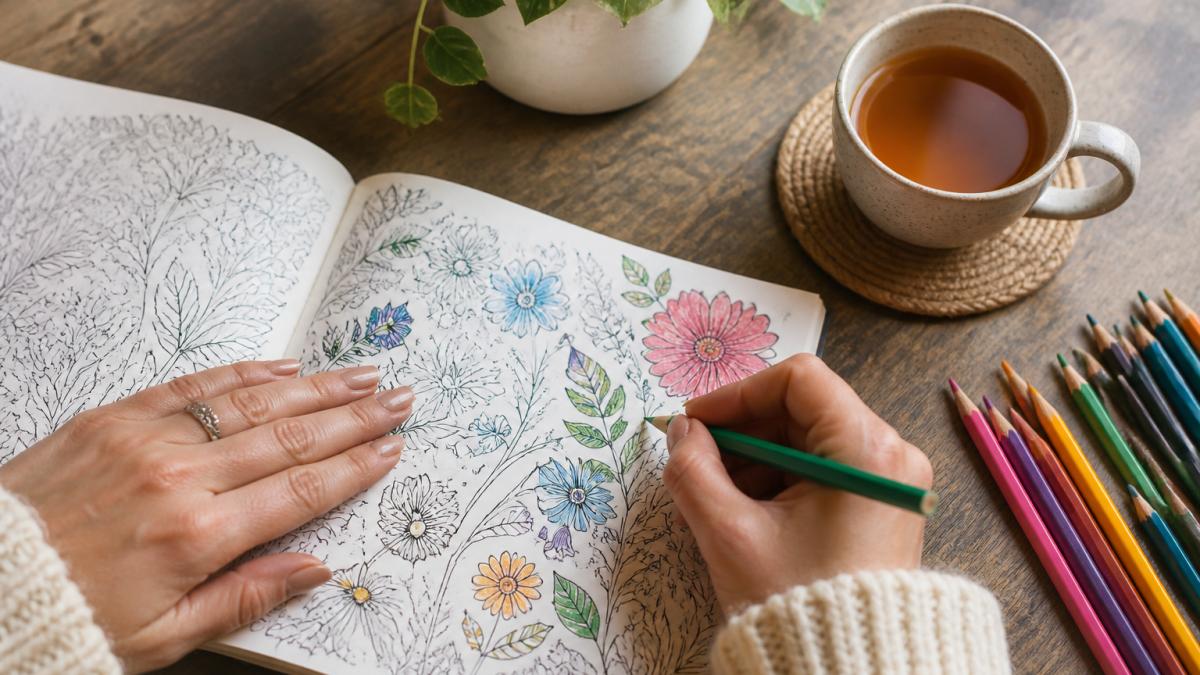
Here is the routine we recommend:
- Choose one book and one page, not the whole book.
- Set a timer for 20 minutes and silence notifications.
- Start with larger spaces, then move to finer details.
- Keep a simple color palette of three to five pencils.
- Stop when the timer ends, even mid-page.
Paper quality and bleed-through: the spec most guides skip
Paper is where cheap coloring books fail, and it is the one thing you can check before you buy. The relevant number is paper weight, usually printed in pounds (lb) or grams per square meter (gsm) on the back cover or listing.
- Under 60 lb (about 90 gsm): thin, office-printer territory. Fine for colored pencils, but markers will ghost or bleed straight through.
- 60-80 lb (about 90-120 gsm): the common middle ground. Colored pencils and gel pens behave well; alcohol markers will still bleed.
- 80-100 lb (about 120-150 gsm): a good target if you plan to use markers. Look for the words "marker-friendly" or "acid-free" on the cover.
- Over 100 lb (about 160 gsm and up): heavy cardstock. Best for wet media like watercolor brush pens, but it raises the price and the book's weight.
Two other specs matter as much as weight:
- Single-sided vs. double-sided pages. Single-sided means you only color one face of each sheet, so bleed-through ruins nothing on the back. Double-sided books are more compact but less forgiving.
- Perforated edges. Perforated pages tear out cleanly for framing or gifting. Non-perforated pages usually require a craft knife and a straightedge, which is a bad idea next to a relaxing activity.
Matching tools to paper
- Colored pencils work on almost any paper and are the safest first purchase. Soft-core brands lay down color with light pressure; harder cores hold a sharp point for tiny details.
- Gel pens glide on smooth paper but can skip on textured stock. Test on the copyright page first.
- Alcohol markers need 80 lb paper or heavier and a blotter sheet behind the page. They are the fastest way to fill large areas but the least forgiving of thin paper.
- Watercolor brush pens need heavy, sized paper (100 lb or more) or the sheet will buckle.
Binding: spiral vs. traditional
Spiral-bound books lie flat, so you can color with one hand and keep your non-dominant hand relaxed, a real difference for anyone with hand fatigue. Traditional perfect-bound books are cheaper and more portable but fight you on the fold, especially near the spine. At a desk, spiral wins; on a train, traditional wins.
A note on digital
If paper specs feel like too much homework, a tablet app removes the variable entirely, no bleed-through, no paper weight, no sharpener. The trade-off is screen time and no finished physical object. Many people run both: an app for short breaks, a paper book for longer evening sessions.
Frequently Asked Questions
Do coloring books actually help with stress?
Yes, coloring engages your brain in a way that lowers activity in the amygdala, the region tied to stress and fear. The repetitive motion of filling in shapes promotes a meditative state and anxiety reduction. Many adults use it as a therapeutic tool to decompress after work or during difficult moments. It works best when paired with intentional focus, not as background noise while multitasking.
What are the best types of coloring books for anxiety?
Books with repetitive geometric patterns, mandalas, and nature scenes tend to work best for anxiety because they offer predictable, soothing structure. Avoid overly complex designs if you are new to coloring, since frustration can counteract the calming effect.
How long should you color to reduce stress?
Even 10 to 15 minutes of focused coloring can shift your mood and lower stress hormones. For deeper benefits, aim for 20 to 30 minutes in a quiet space without screens. The key is consistency, not duration. A short daily session builds a self-care routine faster than one long weekend session.
What supplies do I need to start adult coloring?
You need a coloring book with single-sided pages or perforated edges, a set of colored pencils (soft-core works best for blending), and a pencil sharpener. A clipboard or hard surface helps if you color on the couch. If you plan to use markers, check paper thickness to avoid bleed-through. Start simple and expand your supplies as your practice grows.
Can coloring be considered a form of meditation?
Yes, coloring shares key traits with meditation: focused attention, a repetitive anchor, and a quieting of internal chatter. Psychologists often call it a flow state, where you lose track of time and outside worries. It is not a replacement for clinical treatment, but it is a legitimate relaxation technique that supports mental health and emotional regulation.