

Why Paper Quality Matters in Journals: A 2026 Guide

Table of Contents
- Why Paper Quality Matters in Journals: The Foundation of Your Practice
- The Impact of Paper Weight (GSM) on Writing Experience
- Ink Absorption, Bleed-Through, and Ghosting: The Technical Truth
- How to Prevent Ink Bleed in Journals: A Practical Guide
- Longevity and Archival Quality: Will Your Words Last?
- Journaling for Anxiety Tips: How the Right Paper Supports Your Mind
- The Sensory Science of Paper: Texture, Sound, and Creative Flow
- Frequently Asked Questions
Last Updated: September 15, 2026
Why Paper Quality Matters in Journals: The Foundation of Your Practice
Paper quality determines whether a journal becomes a daily companion or a drawer-bound regret. Paper quality determines whether a journal becomes a daily companion or a drawer-bound regret. The wrong paper can quietly sabotage the habit: ink feathers, pages ghost through, and writing feels like a chore. This guide explains the science behind why paper quality matters in journals, from GSM ratings to archival standards, so you can choose a notebook that supports your practice.
Paper is not a neutral surface; it is an engineered material whose measurable properties shape everything from pen compatibility to how long your words survive. Below, we break down the specifications that matter and how to match a journal to the way you write.
Library of Congress guidance on preservation and paper permanence
The Impact of Paper Weight (GSM) on Writing Experience
Paper weight, measured in grams per square meter (GSM), determines how a journal feels under your pen and how well it resists show-through. Most journals fall between 70 and 160 GSM.
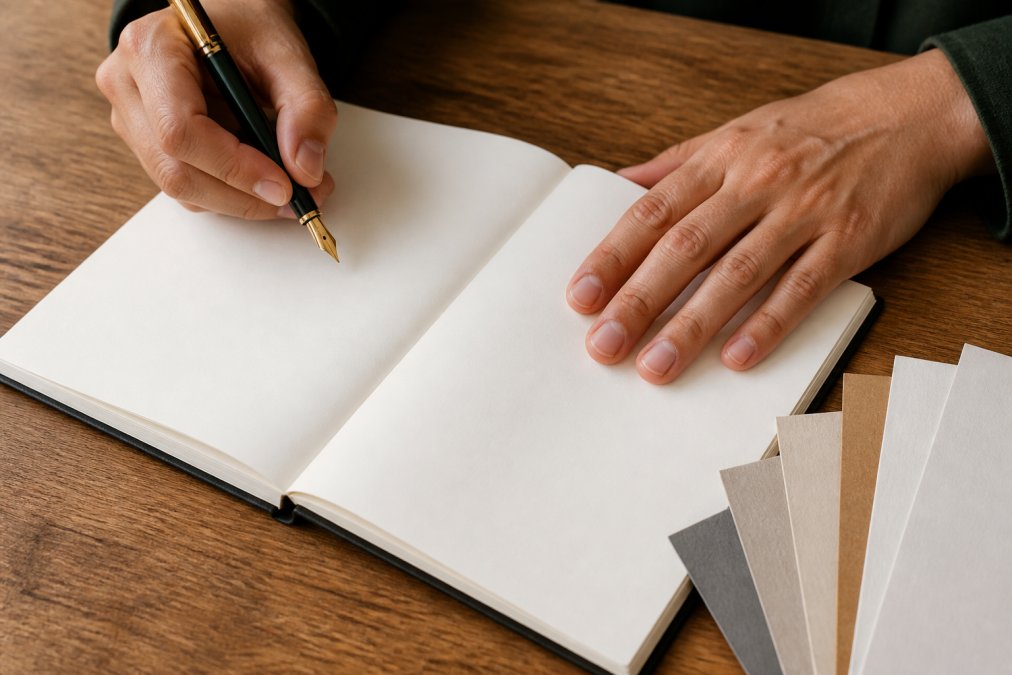
Understanding GSM: What the Numbers Mean
GSM is the weight of one square meter of paper, and it correlates with thickness and stiffness. A 70 GSM sheet feels thin and floppy; a 120 GSM sheet feels substantial. Heavier paper handles wetter inks better but raises cost and bulk.
Best Paper Weight for Journals: Finding Your Ideal Thickness
The best paper weight for journals depends on your pen. Ballpoint and pencil writers are fine with 80-100 GSM; fountain pen users should look for 100-120 GSM or higher; markers and watercolor need 140 GSM and up. There is no universal "best" number, only the best match for your tools.
| Pen or Tool | Recommended GSM | Why |
|---|---|---|
| Pencil, ballpoint | 80-100 | Minimal ink load, low show-through |
| Gel pen | 90-110 | Moderate ink, benefits from surface sizing |
| Fountain pen | 100-120+ | Wet ink needs absorption control |
| Marker, brush pen | 140+ | Heavy saturation, needs opacity |
Ink Absorption, Bleed-Through, and Ghosting: The Technical Truth
Bleed-through happens when ink soaks through the sheet and shows on the reverse; ghosting is the fainter shadow of writing seen through the page. They look similar but have different causes, and fixing one does not fix the other.
Bleed-through is an absorption problem; ghosting is an opacity problem. A 120 GSM sheet can ghost badly if translucent, and a thin 80 GSM sheet can resist bleed if heavily sized. Weight alone predicts neither.
Surface Sizing: The Variable That Controls Feathering
Absorption is governed by surface sizing, a starch or polymer treatment applied during papermaking that controls how quickly ink penetrates the fiber mat. Well-sized paper lets ink sit on the surface long enough to dry without spreading, preventing feathering. Under-sized paper wicks ink sideways and the line blooms.
Sizing comes in two broad forms:
- Surface sizing coats the finished sheet and creates a barrier at the surface. This is what most fountain-pen-friendly journals use.
- Internal sizing is added to the pulp before the sheet forms, making the whole fiber mat more water-resistant. It helps with bleed-through but does less for feathering.
Most quality journals use both. When a label says "fountain pen friendly" without a GSM or sizing claim, that is marketing, not a specification.
Opacity: The Number That Predicts Ghosting
Opacity is measured as a percentage and describes how much light the sheet blocks. A 90% opaque sheet lets 10% of light through, enough to show the reverse under strong light. Most notebook paper sits at 85-92%; heavier, denser, more heavily filled sheets push toward 95% and above, where ghosting effectively disappears.
Opacity rises with basis weight, fiber density, and mineral fillers like calcium carbonate or titanium dioxide. That is why a 100 GSM sheet with high filler content can outperform a 120 GSM sheet with a loose fiber structure.
The Pen-to-Paper Compatibility Matrix
Most guides stop at "use heavier paper." The more useful answer is to match the ink vehicle to the paper's absorption profile: different pen types deliver different volumes of liquid per stroke, and that volume, not the brand, drives the outcome.
| Pen or Tool | Ink Vehicle | Recommended GSM | Sizing Preference | Failure Mode If Mismatched |
|---|---|---|---|---|
| Pencil, ballpoint | Wax or oil paste | 70-90 | Minimal | Grooving, show-through on thin sheets |
| Gel pen | Water-based gel | 90-110 | Moderate surface sizing | Feathering, slow dry, smearing |
| Rollerball | Water-based liquid | 90-110 | Moderate to heavy | Bleed-through on unsized sheets |
| Fountain pen (fine) | Water-based dye | 90-110 | Heavy surface sizing | Feathering along fiber lines |
| Fountain pen (broad, flex) | Water-based dye | 110-140 | Heavy, internal + surface | Bleed-through, long dry times |
| Brush pen, marker | Alcohol or water pigment | 140+ | Coated or heavily sized | Strike-through to the next page |
| Watercolor wash | Water + pigment | 200+ (or dedicated watercolor stock) | Gelatin or synthetic sizing | Cockling, buckling, full strike-through |
Two rules fall out of this matrix. First, the wetter the ink, the more sizing you need, not just more weight. Second, coated paper is not automatically better: glossy coated sheets can cause water-based inks to bead and smear.
How to Test a Journal Before You Commit
You can predict almost everything above in five minutes with the last page of a new journal:
- Draw a single line with your wettest pen and time how long it takes to stop smearing under a fingertip.
- Turn the page and hold it to a lamp. If the line is clearly legible from the reverse, expect ghosting.
- Look at the line edge under a phone camera zoom. A clean edge means good sizing; a fuzzy halo means feathering.
- Write a dense paragraph, not a single word. Bleed-through often only appears where ink overlaps.
- Repeat on page 2 and page 200 if the journal has an index. Inconsistent sizing between signatures is a real manufacturing issue.
A common mistake is blaming the pen when the paper is the problem. If your writing feathers on one journal and behaves on another, the paper's surface sizing is the variable, not your technique.
How to Prevent Ink Bleed in Journals: A Practical Guide
Preventing ink bleed starts with matching your pen to the paper's absorption rate, not writing more lightly. The steps that work:
- Check the GSM rating before buying; 100 GSM is the practical floor for fountain pens.
- Test a new journal's last page with your wettest pen before committing.
Longevity and Archival Quality: Will Your Words Last?
What "Acid-Free" Actually Means
Two related terms matter:
Reading the Label Without Getting Fooled
The Storage Variables You Control
What This Means for Your Journal Choice
Library of Congress guidance on preservation and paper permanence
Journaling for Anxiety Tips: How the Right Paper Supports Your Mind
American Psychological Association overview of journaling and stress
The Sensory Science of Paper: Texture, Sound, and Creative Flow
Frequently Asked Questions
What kind of paper is best for journals?
The best paper for journals depends on your pen choice. For fountain pens, look for acid-free paper with a GSM of 100 or higher, as this prevents bleed-through and feathering. For ballpoint or gel pens, a 70-90 GSM paper works well. If you use markers or heavy inks, choose 120 GSM or above. Always check that the paper is acid-free for archival quality and consider surface sizing, which affects how ink absorbs.
Does paper quality affect the longevity of a journal?
Yes, significantly. Acid-free and lignin-free paper can last for decades or even centuries without yellowing or becoming brittle. Lower-quality paper contains acids that cause it to degrade over time, turning yellow and crumbling. For journals you want to keep, look for paper labeled archival quality. Proper storage away from heat, moisture, and direct sunlight also extends the life of your journal, preserving your writing for future generations.
Why does ink bleed through some journal pages?
Ink bleed occurs when paper lacks sufficient surface sizing or thickness. The ink travels through the paper fibers instead of sitting on the surface. Thin paper (under 70 GSM) and highly absorbent paper are most prone to bleed-through. To prevent this, choose paper with a higher GSM, use a blotter sheet, or switch to a quick-drying pen. Testing your pen on a sample page before writing in your journal can save you from ruining a spread.
Is eco-friendly paper lower quality for journaling?
Not necessarily. Many eco-friendly papers are made from recycled fibers or sustainable sources like bamboo and bagasse, and they can perform just as well as virgin paper. Look for certifications like FSC (Forest Stewardship Council) to ensure responsible sourcing. Some recycled papers have slightly more texture, which many journalers prefer for the tactile feedback. The key is to check the GSM and acid-free status, as these determine performance more than the fiber source.
Choosing a journal is really a decision about how you want to write: smoothly, durably, and without interruption. Discover Amazing Goods curates mindfulness journals built around minimalist, eco-friendly design, with paper chosen to support the practice rather than fight it. Explore our collection, find a journal that matches your pens and your intentions, and add to cart to start writing on paper that holds up.