

Why Minimalist Journals Help Focus

Table of Contents
- What Minimalist Journaling Actually Is
- How Clutter Steals Your Attention and Mental Clarity
- Minimalist Bullet Journal Layout for Productivity
- The Neuroscience Behind Handwriting and Focus
- How Long Should You Journal for Maximum Focus
- Using Minimalist Journaling Prompts for Focus
- Building a Sustainable Minimalist Journaling Habit
- Frequently Asked Questions
Last Updated: September 19, 2026
What Minimalist Journaling Actually Is
Minimalist journaling is the practice of recording thoughts, goals, and reflections using only the essential elements needed to capture meaning, which is precisely why minimalist journals help focus by removing distractions. Rather than elaborate decorations, lengthy narratives, or complex formatting, minimalist journals strip away non-essential details to create a low-friction, distraction-free writing space. This approach removes the cognitive burden of deciding what to include, how to arrange it, or whether your handwriting looks perfect enough. The result is a journal that serves its actual purpose: capturing your thoughts without the overhead.
The core principle behind minimalist journaling is intentionality. Every element on the page exists for a reason. You write what matters, nothing more. This contrasts sharply with traditional journaling, where the pressure to fill pages, create aesthetically pleasing layouts, or maintain consistency often becomes the focus instead of the reflection itself. Minimalist journals eliminate that friction.
At Discover Amazing Goods, we've designed mindfulness journals that embrace this philosophy. Our curated collection of minimalist, eco-friendly journals pairs simple, clean layouts with high-quality paper that invites consistent use. The design removes decision fatigue, making it easier to establish a daily journaling habit without overthinking the process.
How Clutter Steals Your Attention and Mental Clarity
Clutter, whether visual, cognitive, or structural, fragments your focus before you even pick up the pen. When your journal page is filled with decorative elements, color-coded sections, or complex bullet-point systems, your brain has to process all of that before it can settle into reflection. This cognitive load consumes mental energy that should be directed toward your actual thoughts.
Research on attention shows that every visual element competing for your focus requires processing power. A minimalist journal eliminates this competition. A blank page with a single prompt or a few guiding lines creates what researchers call a "low-friction" environment. Your mind isn't distracted by what comes next or whether you're doing it "right."
The psychological effect is measurable in how long you actually journal. Many people find that ornate journals with elaborate systems become overwhelming. The pressure to maintain the aesthetic or follow the system correctly turns journaling from a reflective practice into a performance. Minimalist journals sidestep this entirely. You sit down, write, and move on. No setup time. No pressure to make it look a certain way.
This simplicity also builds consistency, and understanding why minimalist journals help focus reveals that this consistency is the foundation of deeper mental clarity. When journaling feels easy and requires minimal decision-making, you're more likely to do it daily. That consistency compounds over time, deepening the mental clarity benefits that journaling provides.
Minimalist Bullet Journal Layout for Productivity
A minimalist bullet journal layout uses the fewest structural elements needed to organize your thoughts and track your priorities. The traditional bullet journal system can become elaborate, multiple color codes, symbols, and index pages. A minimalist version strips this down to three core elements: a date, a few key entries, and blank space.
The basic structure works like this:
- Date and intention, Start each entry with the date and a single-sentence intention for the day or reflection
- Key points only, Use bullet points for only the thoughts or tasks that matter; skip everything else
- Blank space, Leave significant white space on each page; resist the urge to fill it
This layout prevents overwhelm. You're not managing multiple sections or trying to maintain visual consistency. The journal becomes a tool, not a project. Many people find that this structure actually increases productivity because the simplicity makes daily use automatic. You don't have to think about where to write something; you just write it.
The minimalist approach also supports goal setting and intentionality. By starting each entry with a clear intention, you're anchoring your day around what actually matters. This practice of defining intention before action is a cornerstone of focused, productive work.
The Neuroscience Behind Handwriting and Focus
Handwriting engages distinct neural pathways compared to typing or digital note-taking, a difference that directly impacts focus and retention. When you write by hand, your brain simultaneously activates the motor cortex (controlling fine hand movements), the visual cortex (processing letter formation), and the hippocampus (encoding memory). This multisensory engagement creates stronger neural associations with the information you're recording, a phenomenon researchers call "encoding specificity." Studies using fMRI imaging show that handwritten notes produce more robust activation in memory-related brain regions than typed notes, even when the content is identical.
The tactile feedback of pen on paper adds another layer. Your fingertips send proprioceptive signals back to your brain, creating a closed-loop sensory experience. This feedback grounds your attention in the present moment in a way that screen-based writing cannot replicate. There's no notification to distract you, no hyperlink to follow, no algorithmic feed pulling your focus sideways. The physical constraint of the page, the fact that you cannot scroll infinitely or switch windows, forces your prefrontal cortex to remain engaged with a single task.
A minimalist journal amplifies this neurological advantage by removing competing visual stimuli. Your brain's anterior cingulate cortex, which manages attention allocation, doesn't have to divide resources between content and formatting complexity. Without color-coding systems, decorative elements, or elaborate layouts to process, your entire cognitive capacity channels toward the reflection itself. The result is what neuroscientists call "attentional narrowing", the ability to sustain focus on a single object or thought without distraction.
This is why many people report that handwriting feels more meditative than typing. The combination of motor engagement, sensory feedback, and simplified visual environment creates a neurological state conducive to deep focus. Minimalist journaling removes the friction that would otherwise fragment that state, allowing you to maintain the cognitive conditions that support both clarity and retention.
How Long Should You Journal for Maximum Focus
Optimal journaling duration depends on your goal, your current habit strength, and how you integrate journaling into a broader productivity system. However, the minimalist format fundamentally changes the calculus of how long you should journal, because it removes the setup and decision overhead that inflates duration without adding value.
For habit formation (weeks 1-4): Five to ten minutes daily is ideal. This timeframe is short enough to sustain without requiring the willpower that discourages consistency. The minimalist format is crucial here: because there's no elaborate system to manage, you can sit down and write immediately. No setup time means the entire five minutes is actual reflection, not administrative overhead. Many people fail at journaling because they allocate thirty minutes but spend fifteen minutes deciding where to write, what color pen to use, or how to format the entry. A minimalist journal collapses that friction to near zero.
For habit consolidation (weeks 5-12): As the practice becomes automatic, you may naturally extend to fifteen to twenty minutes. At this point, your brain has begun to anticipate the journaling session, and resistance decreases. You're no longer fighting decision fatigue; you're settling into a rhythm. The minimalist structure still matters here, it allows you to extend duration without adding complexity. You're writing more, not managing more.
For sustained practice (beyond 12 weeks): Most practitioners find that fifteen to twenty minutes remains optimal for daily journaling. Beyond thirty minutes, the benefit plateaus. Extended sessions often shift from reflection into rumination, cycling through the same thoughts without generating new clarity. The exception is occasional longer sessions (forty-five minutes to an hour) used for deeper processing during transitions or decision points, but these work best as weekly or monthly practices, not daily habits.
Integration with productivity frameworks: If you're using journaling as part of a Getting Things Done (GTD) system, your duration should align with your weekly review cycle. A five-minute daily entry captures the day's priorities and blockers; a twenty-minute weekly entry processes those entries into your system. If you're using time-blocking, your journaling session should precede your block-planning, typically ten to fifteen minutes to clarify intentions before you structure your day. A minimalist journal supports this integration because the low-friction format doesn't compete with your other productivity practices; it feeds them.
The consistency principle: Consistency matters far more than duration. A focused ten-minute session where you're fully present produces more focus benefit than a distracted thirty-minute session where you're managing journal complexity. The minimalist approach protects consistency by removing the variables that cause people to skip sessions or abandon the practice. When journaling requires no setup, no aesthetic maintenance, and no decision-making, you're far more likely to show up daily. That daily practice compounds into the mental clarity and focus benefits that journaling provides.
Using Minimalist Journaling Prompts for Focus
Minimalist journaling prompts guide your reflection without constraining it. A good prompt is simple, open-ended, and designed to clarify thinking rather than generate lengthy responses. Examples include: "What's one thing I need to focus on today?" or "What's distracting me right now?"
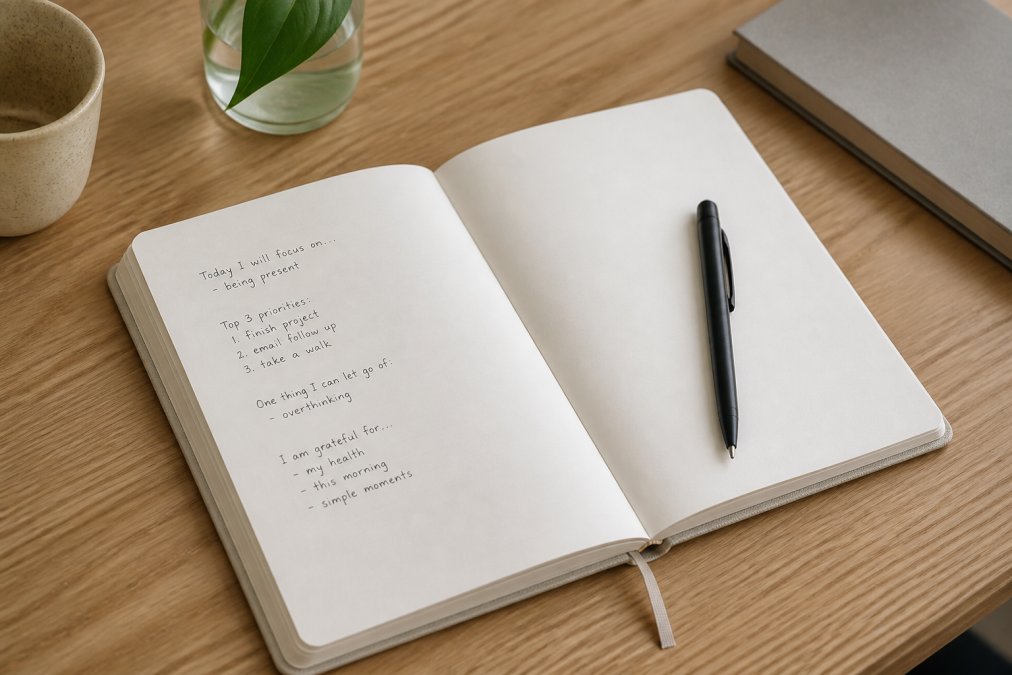
These prompts serve two functions. First, they reduce decision fatigue. You don't have to decide what to write about; the prompt gives you a starting point. Second, they anchor your reflection around intentionality and focus.
Building a Sustainable Minimalist Journaling Habit
Building a habit requires removing barriers to consistency. A minimalist journal removes the most common barriers: decision fatigue, aesthetic pressure, and setup time. You pick up the journal, write, and you're done. This simplicity is what makes the habit stick.
Frequently Asked Questions
Can minimalist journaling help reduce cognitive overload?
Yes. Minimalist journals reduce cognitive load by eliminating visual noise and non-essential design elements. When you remove decorative clutter, your brain processes less information and can focus more intently on what you're writing. This streamlined approach lowers overwhelm and makes journaling feel more manageable, which increases the likelihood you'll maintain the habit consistently.
Is it true that handwriting in a minimalist journal improves memory and focus?
Handwriting engages different neural pathways than typing. The physical act of writing by hand requires more intentional thought, which strengthens memory encoding and deepens focus. Combined with a minimalist layout that removes distractions, handwriting creates a low-friction environment where your brain can concentrate fully on self-reflection and goal setting without competing visual stimuli.
How does a minimalist journal layout prevent journaling burnout?
Minimalist designs reduce the pressure to make entries perfect or aesthetically pleasing. Without the expectation of elaborate decoration or complex layouts, you spend less time on formatting and more time on meaningful reflection. This removes a common barrier to consistency and helps journaling feel like a sustainable daily practice rather than a chore.
What do psychologists say about journaling and mental clarity?
Psychologists recognize journaling as an effective tool for organizing thoughts and reducing mental clutter. The act of externalizing your thoughts onto paper helps you process emotions, clarify priorities, and gain perspective. A minimalist approach amplifies these benefits by creating a distraction-free space where your mind can fully engage in self-reflection and intentionality without competing stimuli.