

Sustainable Tools for Mindful Family Routines

Table of Contents
- Why Sustainable Tools Make Mindful Family Routines Stick
- Mindfulness Activities for Families That Need Almost No Supplies
- Sustainable Daily Practices for Families: A Routine Plan by Time of Day
- Choosing Sustainable Tools: What to Look For (and What to Skip)
- Children's Books About Recycling and Sustainability That Spark Real Conversations
- A Mindful Bedtime Routine for Children Using Sustainable Tools
- Adapting Practices for Different Ages, Needs, and Sensory Preferences
- How to Measure Progress Without Turning Mindfulness Into a Performance
- Frequently Asked Questions
Last Updated: October 5, 2026
Why Sustainable Tools Make Mindful Family Routines Stick
Sustainable tools for mindful family routines remove two barriers at once: cost and clutter.
The research on habit formation supports the practical approach. According to research on habit formation and repetition, repeated cues in a stable environment are what turn an intention into an automatic behavior.
Here is the core insight most guides miss: the tool matters less than the cue. A gratitude jar on the counter is a cue.
Below, we show you how to build a full day of mindful family routines using supplies you likely already have, plus a few sustainable tools worth buying once.
Mindfulness Activities for Families That Need Almost No Supplies
Mindfulness activities for families do not require a shopping trip. The best ones use your body, your breath, and a few household items. Starting with zero purchases makes the habit easier to keep, because there is nothing to lose or replace.
Try these low-supply activities first:
- Five-finger breathing. Trace each finger while breathing in and out. No materials needed.
- The listening game. Ring a bell or tap a glass, then count how long the sound lasts.
- A shared coloring page. One page, two people, no screens.
A common mistake is buying a full mindfulness kit before testing whether your family enjoys the practice. Start free. Add tools only for the activities your family actually repeats.
Breathing Exercises and Quiet Moments You Can Do Anywhere
Breathing exercises are the simplest sustainable tool because they cost nothing and never wear out. Try the 4-4-6 pattern: breathe in for four counts, hold for four, out for six. Kids as young as five can follow along once you count out loud.
Quiet moments work best when short and predictable. Try two minutes after school, or one minute before dinner. The goal is a shared pause everyone can count on.
Sustainable Daily Practices for Families: A Routine Plan by Time of Day
A routine plan by time of day turns good intentions into a schedule your family can actually follow. According to guidance on building habits through existing routines, linking a new behavior to an existing one is one of the most reliable ways to make it stick.
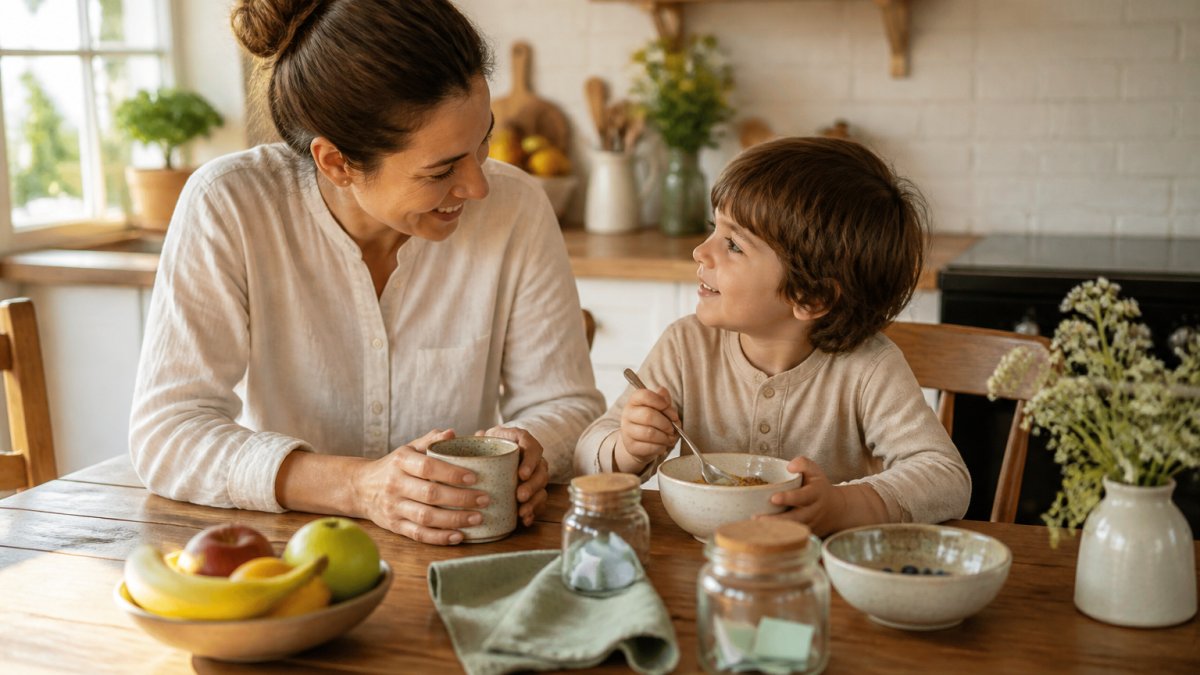
Here is how a full day can look:
| Time of Day | Practice | Materials Needed | Time |
|---|---|---|---|
| Morning | Device-free breakfast and one gratitude | Gratitude jar, cloth napkins | 10 min |
| After school | Breathing exercises and a quiet moment | None | 2-3 min |
| Dinner | One-sentence check-in per person | None | 5 min |
| Evening | Reflection and wind-down | Journal, soft lamp | 10 min |
| Bedtime | Story and three slow breaths | A book, a nightlight | 15 min |
Morning: Device-Free Meals and Gratitude
Device-free meals are the single highest-impact change most families can make. Put phones in a basket by the door. Ask one gratitude question: "What is one good thing from yesterday?" Write the answer on a slip of paper and drop it in a jar. Over a year, that jar becomes a record of your family's good days.
Evening: Reflection and Wind-Down
Evening reflection closes the loop. A shared journal works better than individual ones for younger kids, because they can draw instead of write. Dim the lights, keep the same order of events, and end with three slow breaths.
Choosing Sustainable Tools: What to Look For (and What to Skip)
Most guides on mindful family routines either ignore tools or push a kit. The gap is practical selection guidance: how to pick durable, low-waste items that survive years of daily use, and when to skip a purchase. Choosing sustainable tools comes down to four questions: Will it last through hundreds of uses? Can it be repaired, refilled, or repurposed? Does it replace something disposable you already buy?
What to look for:
- Recycled or FSC-certified paper in journals and activity books. The Forest Stewardship Council certifies paper from responsibly managed forests, and the label is printed on the product or packaging.
- Soy or vegetable-based inks instead of petroleum-based ones. These are common in books printed domestically and are noted on the copyright page.
- Refillable or repairable items, like a glass jar with a replaceable lid, a mechanical pencil that takes standard lead, or a sewn-binding journal that will not shed pages.
What to skip:
- Kits with single-use parts that cannot be replaced, such as a one-time craft set with glued-in components.
- Items marketed as "eco" without a specific material claim. If the label names neither material nor certification, treat it as marketing.
- Anything that duplicates a tool you already own. A second journal does not make the first one more sustainable.
Reusable Materials, Low-Waste Choices, and Family Participation
Reusable materials and low-waste choices work best when kids help choose them.
A free or repurposed approach is often the strongest start. A cleaned pasta sauce jar becomes a gratitude jar.
When you do buy, buy once and buy repairable. A sewn-binding hardcover journal can outlast several glued paperbacks.
Do not buy a full set of matching mindfulness supplies for every family member at once. If the routine does not stick, you are left with unused items. Buy one shared tool first, then add individual ones once the habit holds.
For families who want a ready-made option, our mindfulness journals and activity books use minimalist, eco-friendly designs and combine multiple activities like color-by-number and dot-to-dot.
Children's Books About Recycling and Sustainability That Spark Real Conversations
Children's books about recycling and sustainability turn abstract ideas into stories kids can follow. The best ones show cause and effect: a bottle becomes a new bottle, a tree becomes paper, a broken toy gets repaired instead of replaced.
Look for books that:
- Show the full journey of a material, not just the bin
- Include a character your child can relate to
- End with one action a child can take that week
- Avoid guilt-based messaging, which tends to shut down conversation
After reading, ask one open question: "What could we reuse at home this week?" Then do it together. A single repaired item teaches more than a dozen facts.
A Mindful Bedtime Routine for Children Using Sustainable Tools
A mindful bedtime routine for children works best when it is short, dim, and identical every night. According to guidance from the American Academy of Pediatrics on sleep routines for children, a consistent bedtime routine helps children fall asleep faster and sleep better.
A simple sequence:
- Dim the lights and put devices away
- Read one story from a real book
- Name one good thing from the day
- Take three slow breaths together
- Say goodnight in the same words every night
Sustainable tools make this easier to keep. A cloth bookmark, a repaired nightlight, and a well-made book that survives years of bedtime reading all reduce waste. A sturdy book read three hundred times beats three flimsy ones read once.
Adapting Practices for Different Ages, Needs, and Sensory Preferences
Adapting practices for different ages and needs is not a compromise. It is the difference between a routine that works and one that gets abandoned. Every child responds to different levels of sound, light, and touch, and the same practice that calms one child can overwhelm another. Match the practice to the person, not the person to the practice.
Adjust by age:
- Ages 2-4: One-minute practices, lots of touch and movement. A hand on the chest during a breath, a stuffed animal that "breathes" with them, or a song with a slow rhythm. Sitting still is not the goal at this age.
- Ages 5-7: Counting breaths, simple gratitude questions, and short guided imagery. "Imagine you are a tree with roots going down" works better than "clear your mind."
- Ages 8-12: Journaling, longer quiet moments, and choosing their own practice. Let them pick between two options so they feel agency without being overwhelmed.
- Teens: Private reflection, music, or a walk instead of a sit-down practice. Teens often prefer to lead or to practice alone, and both are valid.
Adjust for sensory needs:
- Offer headphones or ear defenders during loud activities, and let a child wear them during quiet ones if silence feels uncomfortable.
- Swap scented candles for unscented ones, or skip them entirely. Synthetic fragrance is a common trigger for headaches and sensory overload.
- Allow movement instead of stillness if sitting is hard. Walking, rocking, or squeezing a stress ball can serve the same regulating purpose as a seated breath.
- Dim the lights or offer sunglasses if bright rooms are uncomfortable.
For children who find silence, breath focus, or stillness uncomfortable, offer alternatives that reach the same goal through a different channel:
- Movement-based: A slow walk, stretching, or carrying something heavy across the room.
- Sound-based: Humming, listening to a single instrument, or naming sounds in the room.
- Touch-based: Holding a smooth stone, kneading dough, or wrapping in a weighted blanket.
- Visual-based: Watching a lava lamp, a snow globe, or leaves moving outside.
The routine serves the family, not the other way around. If a practice causes stress, change the practice, not the child.
How to Measure Progress Without Turning Mindfulness Into a Performance
Measure progress by consistency, not by how calm anyone looks. Tracking streaks, moods, or "success" turns a stress-relief practice into another thing to fail at.
Better signals to watch:
- Does the routine still happen most days?
- Do family members remind each other to do it?
- Has conflict at transition times, like bedtime, gotten shorter?
- Does anyone ask for the practice on their own?
A simple paper tracker on the fridge works fine. Mark the days you practiced, not how well it went. After a month, look at the pattern, not the score.
Building a routine that lasts is hard when the tools around you are disposable, complicated, or designed to be replaced. Discover Amazing Goods offers curated activity books, coloring books, and mindfulness journals built around minimalist, eco-friendly designs, with screen-free activities that build focus and fine motor skills for kids and adults alike.
Frequently Asked Questions
What reusable tools can help make family routines more mindful?
Reusable tools reduce waste and create consistent cues for calm. A cloth pouch for breath cards, a wooden gratitude bowl, beeswax crayons, and a set of washable cloth wipes for cleanup all work well. A single high-quality mindfulness journal or activity book that the family uses together also replaces dozens of disposable worksheets. The key is choosing items that fit your existing routine rather than adding a new chore. Start with one tool, keep it visible, and let it become part of the rhythm.
How can families make everyday routines more sustainable?
Small swaps add up. Replace paper napkins with cloth, use a refillable water bottle at every meal, and store art supplies in a repurposed jar or tin. For quiet time, choose reusable activity books or a family mindfulness journal instead of printing new coloring pages each day. When you buy new items, look for recycled paper, soy-based inks, and plastic-free packaging. These sustainable daily practices for families work best when they are tied to a routine you already have, like dinner or bedtime.
What are some mindfulness activities families can do together?
Try a three-breath pause before meals, a one-sentence gratitude round at dinner, or a silent minute while looking out a window. For younger children, a color-by-number page or a dot-to-dot activity can be a shared quiet moment. Older kids might prefer a short body scan before bed. The activity matters less than doing it at the same time each day. Even five minutes of shared practice builds connection and helps everyone regulate emotions without extra planning.
How can parents encourage children to reuse and recycle books and creative materials?
Make reuse visible and fun. Set up a 'book hospital' with tape and cardstock for torn pages, host a neighborhood book swap, and turn finished coloring pages into wrapping paper or collages. Read children's books about recycling and sustainability together, then ask your child what the characters could have done differently. Keep a bin for scrap paper, fabric, and cardboard near the art area. When children see materials being used again, recycling becomes a habit rather than a lecture.