

Sustainable Materials for Children Books: A 2026 Guide

Table of Contents
- Why Sustainable Materials for Children Books Matter in 2026
- 1. Recycled Paper and Paperboard: The Foundation of Eco-Friendly Books
- 2. FSC-Certified Children's Books: What the Label Actually Means
- 3. Soy-Based Ink Benefits for Children's Book Printing
- 4. Plastic-Free School Supplies for Kids: Beyond the Book Itself
- 5. Physical Material Transparency: What Publishers Don't Tell You
- 6. End-of-Life Cycle: Recycling, Donating, and Composting Books
- 7. Digital vs. Physical Sustainability: Which Is Greener for Young Readers?
- Frequently Asked Questions
Last Updated: September 10, 2026
Why Sustainable Materials for Children Books Matter in 2026
Parents today ask harder questions about what they bring into their homes. That scrutiny now extends to the bookshelf. Sustainable materials for children books is the practice of choosing books printed on recycled or responsibly sourced paper with non-toxic, low-impact inks and plastic-free bindings. This guide walks through the seven material choices that matter most, from recycled paperboard to end-of-life recycling.
The stakes are real. Children's books take a beating: chewed corners, spilled juice, repeated readings. Books built from cheap coated paper and petroleum-based inks wear out fast and end up in landfills. Books built from recycled fiber and soy-based ink hold up longer and break down more cleanly.
Below, we break down each material option, what the labels actually mean, and where greenwashing hides.
1. Recycled Paper and Paperboard: The Foundation of Eco-Friendly Books
Recycled paperboard is the backbone of any eco-friendly children's book. Board books made from post-consumer recycled content resist bending and tearing because the fiber is pressed denser than standard paper. A common mistake is assuming all "recycled" labels mean the same thing. Pre-consumer waste (factory scraps) is easier to source but delivers less environmental benefit than post-consumer content.
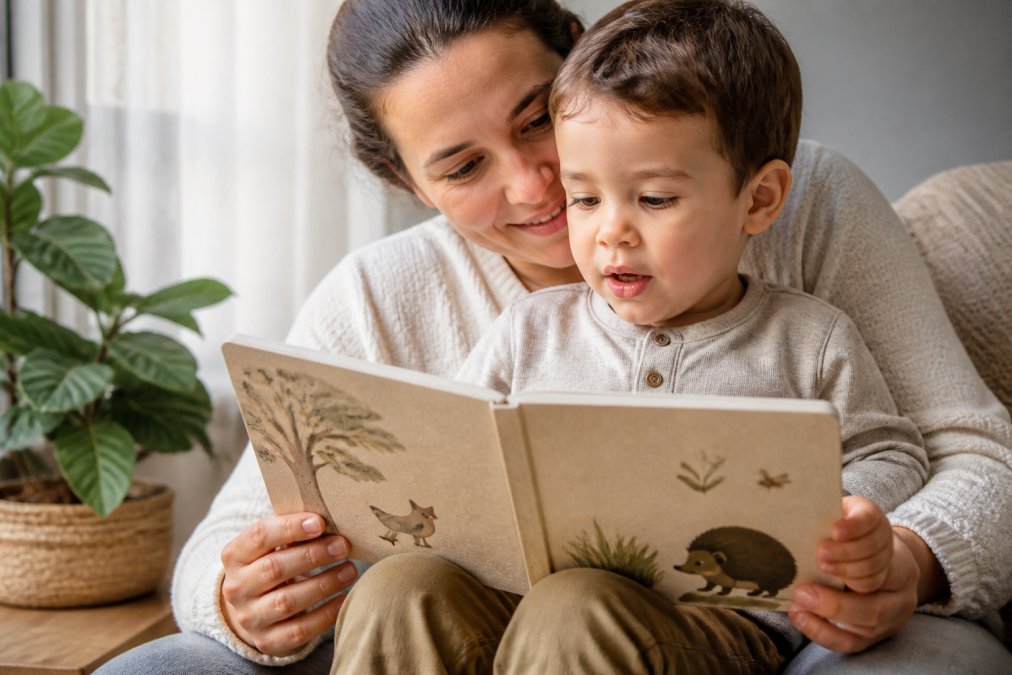
How recycled content affects durability in board books
Higher post-consumer content generally means thicker, stiffer pages, which matters for toddlers who bend and bite. The trade-off is print surface: heavily recycled stock can look slightly warmer in tone. Many publishers compensate with a thin clay coating, though that coating can reduce recyclability at end of life.
What to check on a recycled paper label
Look for a stated percentage of post-consumer waste, not just the word "recycled." A label reading "100% recycled, 90% post-consumer" tells you far more than a generic green leaf icon. If a publisher won't state the percentage, treat the claim as marketing until proven otherwise.
2. FSC-Certified Children's Books: What the Label Actually Means
FSC-certified children's books carry a label from the Forest Stewardship Council, an independent body that verifies wood fiber comes from responsibly managed forests. The certification covers the entire chain of custody, from forest to printer, which is why it's one of the few labels worth trusting at face value. But "FSC-certified" is not a single thing, and the difference between the variants is where most parents get misled.
The three FSC label variants, and why they are not equal
- FSC 100%, every fiber in the product comes from FSC-certified forests. This is the strongest claim and the hardest to source at scale, which is why it appears mostly on premium or small-batch children's titles.
- FSC Mix, a blend of certified forest fiber, reclaimed (recycled) material, and "controlled wood." Controlled wood is the loophole worth understanding: it is not certified, only screened to avoid the worst sources (illegal logging, conversion of high-conservation forests, human-rights abuses). It is better than nothing and weaker than certified.
- FSC Recycled, all fiber is reclaimed pre- or post-consumer material. This aligns best with circular-economy goals because no new timber is cut, but it says nothing about the durability of the resulting paper.
A publisher who prints "FSC-certified" without naming the variant is usually running FSC Mix. That is not a scandal, but it is not the same guarantee as FSC 100%, and the label alone won't tell you which you're holding.
How to verify a certification is real
Every legitimate FSC certificate has a unique code printed near the logo, usually formatted as a letter prefix followed by digits (for example, a code beginning with "FSC-C" or "FSC-C0"). You can enter that code into the FSC certificate database to confirm the printer or publisher is actually certified, and to see which product categories the certificate covers. A logo without a code is a red flag. So is a code that resolves to a printer rather than the publisher, which can mean the publisher is borrowing someone else's certification for marketing.
What FSC does not cover
FSC governs fiber sourcing only. It says nothing about ink chemistry, binding adhesives, cover lamination, or whether the book was shipped in plastic. A book can be FSC Mix and still be printed with petroleum ink and wrapped in shrink film. Treat the FSC label as one data point, not a complete sustainability verdict, pair it with the ink and binding questions in the next sections.
3. Soy-Based Ink Benefits for Children's Book Printing
Soy-based ink benefits start with safety. Soy ink is made from soybean oil rather than petroleum, which means lower volatile organic compound emissions during printing and no heavy metals in the pigment (the EPA). For parents worried about toddlers mouthing book pages, that difference matters.
Are soy inks safe for toddlers who chew books?
No ink is meant to be eaten, but soy-based inks are considered far less concerning than petroleum inks if a small amount is ingested. They contain no known carcinogens at the levels used in printing. Board books with rounded corners and soy inks are the safest practical combination for the chewing stage.
Print quality and color vibrancy compared to petroleum inks
Soy inks once had a reputation for duller color. That gap has closed. Modern soy formulations produce bright, saturated color on coated and uncoated stock alike, and they resist fading better over time. The one drawback: soy inks can take slightly longer to dry on certain presses, which some large printers still cite as a reason to stick with conventional inks.
4. Plastic-Free School Supplies for Kids: Beyond the Book Itself
Plastic-free school supplies for kids extend the sustainability question past the cover. A book shipped in a poly bag, wrapped in shrink film, or finished with a plastic-laminated cover undoes much of the good done by recycled paper. Packaging and finishing choices are where most publishers quietly cut corners, and where the physical-material transparency gap in children's publishing is widest.
The cover finish: the single biggest hidden plastic in a children's book
Most mass-market board books and picture books carry a plastic lamination, a thin film of polypropylene or polyester heat-bonded to the cover (the EPA). It resists scuffs, spills, and sticky fingers, which is why publishers love it. It also makes the cover non-recyclable in most municipal programs and non-compostable everywhere.
The alternatives, in rough order of sustainability:
- Aqueous (water-based) coating, a clear water-based varnish applied like ink. Recyclable with the paper in most programs, decent scuff resistance, less glossy than laminate.
- UV coating, cured with ultraviolet light, solvent-free, but the cured film can complicate repulping. Better than laminate, worse than aqueous.
- Bare, uncoated paper, fully recyclable and compostable, but it scuffs, stains, and shows every juice spill. Rare on children's books for obvious reasons.
If a publisher's website says "paper-finished cover" or "aqueous coating," that is a meaningful claim. If it says nothing, assume laminate.
Binding: where the glue hides
Binding adhesive is the second invisible plastic. Mass-market books typically use EVA (ethylene-vinyl acetate) hot melt, a synthetic glue that is cheap, fast, and difficult to separate from paper fiber during recycling. Better options:
- PUR (polyurethane reactive), stronger and more flexible than EVA, holds up to repeated page-turning, but still synthetic and not compostable.
- Water-based (starch or PVA) adhesives, the standard for higher-end and eco-focused children's books. They break down more cleanly in repulping and are the adhesive to look for if end-of-life recycling matters to you.
- Smyth-sewn binding, folded sections stitched with thread rather than glued at the spine. No plastic spine, holds up better under toddler abuse, and separates cleanly during recycling. This is the gold standard for a durable, plastic-free children's book.
Packaging choices that make a difference
Paper wraps, recycled cardboard mailers, and compostable bands replace plastic film without sacrificing protection. For bulk orders, look for publishers who ship in unbleached corrugated boxes rather than poly mailers. These choices also reduce waste in the classroom, since teachers can recycle the packaging alongside the books. A single shrink-wrapped picture book is a small thing; a classroom set of thirty is a measurable pile of film.
5. Physical Material Transparency: What Publishers Don't Tell You
Physical material transparency is the gap most publishers leave open. Plenty of books carry a leaf logo and a vague claim about "eco-friendly printing," then say nothing about fiber sourcing, ink chemistry, or binding adhesives. That silence is where greenwashing lives.
Questions to ask before buying
- What percentage of the paper is post-consumer recycled content?
- Which FSC category applies, and what is the certificate code?
- Are the inks soy-based or petroleum-based?
- Is the binding glue water-based or synthetic?
- Is the cover plastic-laminated or paper-finished?
A publisher who can answer these five questions without hesitation is worth your money. One who deflects is telling you something too.
Red flags that signal greenwashing
Vague terms like "earth-friendly" or "natural" with no certification, a green logo with no verifiable code, and claims about "saving trees" with no sourcing detail are all warning signs. So is a publisher who talks only about the story's environmental theme and never about the physical book.
6. End-of-Life Cycle: Recycling, Donating, and Composting Books
What happens to a children's book after the last reading matters as much as how it was made. Board books with plastic-laminated covers and synthetic glue are hard to recycle and often get landfilled. Books with paper covers and water-based adhesives break down far more cleanly.
What happens to books in the recycling stream
Most municipal recycling programs accept paperback books with the covers removed, since the paper fiber is recoverable. Hardcovers and board books are trickier: the glued spine and any plastic coating contaminate the batch. Check your local program's rules before tossing a board book in the bin.
Donation options that keep books in circulation
Libraries, shelters, pediatric clinics, and literacy nonprofits accept gently used children's books. Donation extends a book's useful life by years, which is the single highest-impact end-of-life choice. For worn-out books beyond saving, check whether your area offers a book-specific recycling drop-off.
7. Digital vs. Physical Sustainability: Which Is Greener for Young Readers?
Digital reading is not automatically greener. E-readers and tablets carry significant manufacturing footprints, and the electricity to charge and run them adds up over years of use. A single device requires mining, assembly, and shipping before a child reads a single page.
The carbon footprint of screens versus paper
A printed book made from recycled fiber and soy ink has a modest, front-loaded footprint. A tablet has a larger manufacturing footprint but spreads it across thousands of reading hours. The greener choice depends on how many books a device replaces. For a child who reads a handful of titles, physical books made from sustainable materials win.
Why physical books still win for early childhood development
Physical books build fine motor skills through page-turning, support joint attention between parent and child, and provide screen-free entertainment that doesn't fragment focus. The American Academy of Pediatrics continues to recommend shared reading with print books for young children. For early readers, the developmental case and the sustainability case point the same direction: choose well-made physical books.
| Material Choice | Best For | Watch Out For |
|---|---|---|
| Recycled paperboard | Board books, toddlers | Lower post-consumer % weakens durability |
| FSC-certified fiber | Sourcing guarantee | "FSC Mix" is weaker than "FSC 100%" |
| Soy-based ink | Chewing-stage readers | Slower drying on some presses |
| Plastic-free packaging | Bulk and classroom orders | Less water resistance in transit |
| Paper-finished covers | Recycling and donation | Less scuff resistance than laminate |
Choosing books made from genuinely sustainable materials takes more work than grabbing whatever is on the shelf, but the payoff is a longer-lasting book, a smaller footprint, and a child who grows up understanding that what things are made of matters. Our curated selection of children's activity books, coloring books, and mindfulness journals is built around minimalist, eco-friendly designs that support screen-free learning and creativity. Browse the collection and add to cart to bring home books your kids will read, and re-read, for years.
Frequently Asked Questions
What materials are used to make eco-friendly children's books?
Eco-friendly children's books typically use recycled paper or FSC-certified paperboard for pages and covers. Many publishers choose soy-based or vegetable-based inks instead of petroleum inks. Bindings may use water-based adhesives rather than synthetic glues. Some books also feature plastic-free packaging and non-toxic finishes. When evaluating sustainable materials for children books, look for these specific components listed on the publisher's website or inside the book itself.
Are soy-based inks safe for children's books?
Soy-based inks are generally considered safer than traditional petroleum-based inks because they come from renewable resources and contain lower levels of volatile organic compounds. The soy-based ink benefits include reduced environmental impact during production and fewer harsh chemicals in the final product. However, no ink is completely edible, so supervise toddlers who mouth books. For parents concerned about safety, soy inks represent a cleaner choice, especially when combined with non-toxic paper treatments.
What does FSC-certified paper mean for book production?
FSC-certified children's books use paper that meets standards set by the Forest Stewardship Council. This certification ensures the wood pulp comes from responsibly managed forests that protect biodiversity and workers' rights. There are three categories: FSC 100% (all virgin wood from certified forests), FSC Mix (a blend of certified, recycled, and controlled wood), and FSC Recycled (all recycled content). Checking for an FSC label is one of the most reliable ways to confirm sustainable sourcing.
Are recycled board books durable enough for toddlers?
Yes, recycled board books can be just as durable as those made from virgin paperboard. The key is the thickness and density of the recycled paperboard, not whether it is recycled. High-quality recycled board books typically use multiple layers pressed together, creating a sturdy page that withstands chewing and bending. When shopping, look for books labeled as having thick board pages or check customer reviews for durability feedback. Many parents find these books last through multiple children.