

How to Encourage Focus in Children: A Parent's Guide

Table of Contents
- Why Your Child's Attention Span Isn't Broken
- Age-Specific Attention Span Milestones: What's Normal at Every Stage
- Attention Span Exercises for Toddlers: Building Focus Through Play
- Activities to Improve Concentration in Children: A Practical List
- How to Teach Mindfulness to Kids Without the Eye Rolls
- Environmental Tweaks That Reduce Distractions at Home
- Screen Time, Nutrition, and Movement: The Overlooked Focus Factors
- When to Seek Professional Guidance for Focus Challenges
- Frequently Asked Questions
Last Updated: October 2, 2026
Why Your Child's Attention Span Isn't Broken
Your child's attention span isn't broken, it's developing on its own timeline, and most parents misread normal development as a problem. Learning how to encourage focus in children starts with understanding the growing brain. This guide covers age-by-age milestones, practical exercises, and the overlooked factors (screens, food, movement) that shape concentration.
Here's the core idea: focus is a skill, not a trait. Kids build it the same way they build reading or riding a bike, through practice, patience, and the right conditions. The American Academy of Pediatrics notes that attention develops gradually and varies widely between children of the same age (HealthyChildren.org on attention and focus).
Age-Specific Attention Span Milestones: What's Normal at Every Stage
A rough rule of thumb: sustained attention span in minutes is often close to a child's age plus two. A 4-year-old might focus about 6 minutes on a self-chosen task; a 7-year-old, 9 to 12 minutes.
| Age | Typical Focus Window | What It Looks Like |
|---|---|---|
| 2-3 years | 3-6 minutes | Short bursts of play, frequent task switching |
| 4-5 years | 6-10 minutes | Completes simple puzzles, follows one-step directions |
| 6-8 years | 10-15 minutes | Finishes short worksheets, listens during story time |
| 9-12 years | 20-30 minutes | Handles multi-step projects with breaks |
| 13+ years | 30-45+ minutes | Sustained reading, multi-day assignments, self-directed study |
These windows describe sustained attention, staying on one task. Executive function (impulse control, task initiation) develops more slowly into the teen years. That's why a 6-year-old can focus on a favorite game but struggle to start homework.
What's actually developing at each stage
The numbers matter less than the mechanism. Here's what's changing under the hood, and the tactic for each stage.
Toddlers (2-3). Attention is driven almost entirely by interest, and the prefrontal cortex is immature, so "waiting" and "finishing" aren't skills yet.
Early elementary (6-8). Working memory and impulse control strengthen slowly.
Middle childhood (9-12). Executive function can handle multi-step projects, but stamina still needs scaffolding.
The two mistakes parents make with milestones
Mistake one: comparing siblings. Two kids in the same family can differ by years in executive function. A younger sibling who focuses "better" isn't more disciplined, they may simply tolerate boredom longer.
Mistake two: treating a missed window as a red flag. Falling short on a tired Tuesday is normal. Consistently falling far below for their age, across settings, warrants a pediatrician conversation.
Attention Span Exercises for Toddlers: Building Focus Through Play
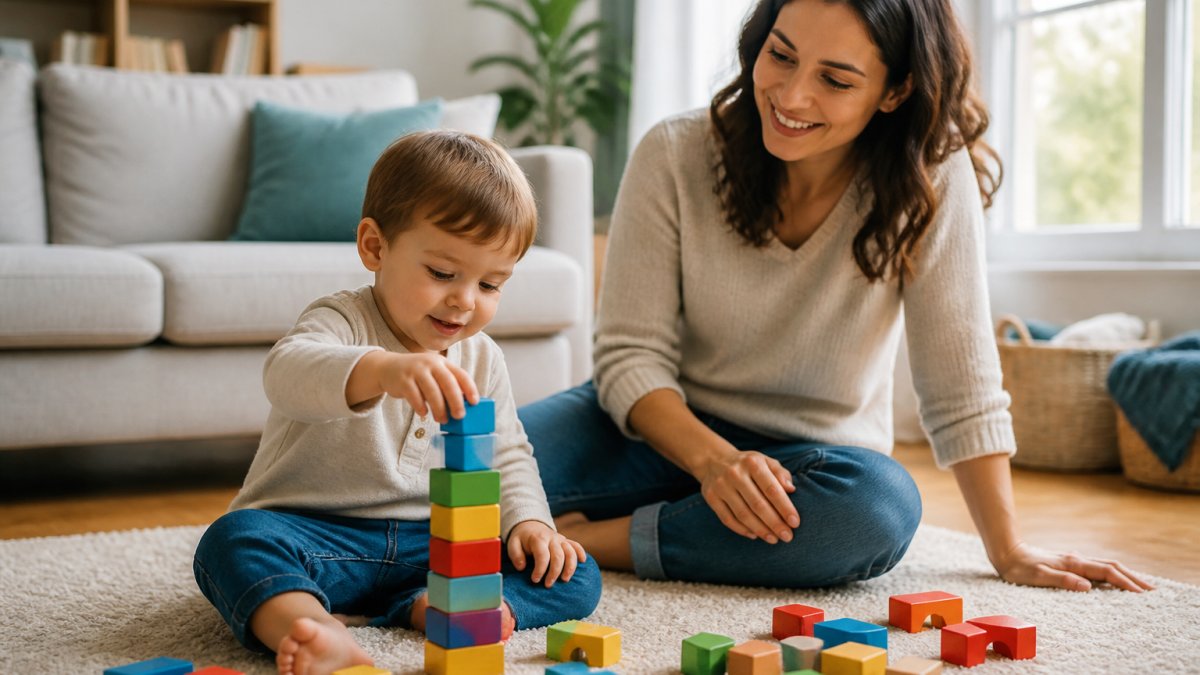
Toddlers build focus through play, not drills. Follow their lead and stretch attention a little at a time. Try these attention span exercises for toddlers:
- Stack and knock down: Build a tower together, then let them knock it over. Repeat.
- Simple puzzles: Start with 3-4 large pieces. Add more as they master it.
- Color-by-number pages: These combine matching, counting, and hand control.
- Dot-to-dot activities: Kids trace the numbers and reveal a picture.
- Sorting games: Group blocks by color or shape.
Each stretches task decomposition and visual reinforcement, holding a goal in mind and working toward it. Keep sessions short: five minutes of engaged play beats twenty minutes of resistance.
Activities to Improve Concentration in Children: A Practical List
The best activities to improve concentration in children are hands-on, have a clear goal, and genuinely interest the child. Here's a list to rotate through:
- Board and card games. Turn-taking builds impulse control and active listening.
- Memory matching games. These train working memory and sustained attention.
- Building sets. Blocks, magnetic tiles, and model kits reward follow-through.
- Puzzles of increasing difficulty. Start easy, then add pieces.
- Cooking simple recipes. Measuring and sequencing build executive function.
- Gardening or plant care. Daily check-ins teach routine building.
- Music practice. Reading notes and keeping rhythm demand focused attention.
- Coloring and drawing. Detailed coloring books build concentration stamina.
Rotate activities so novelty stays high, but repeat favorites so skills deepen. Aim for 15 to 30 minutes of focused activity per session for school-age kids, with breaks as needed.
How to Teach Mindfulness to Kids Without the Eye Rolls
Mindfulness for kids works best when it's short, physical, and framed as a game. Skip the meditation cushion. Try these:
- Belly breathing: Lie down with a stuffed animal on the belly. Watch it rise and fall.
- Five senses check: Name 5 things you see, 4 you hear, 3 you feel, 2 you smell, 1 you taste.
- Mindful eating: Eat one raisin or berry slowly, noticing texture and taste.
- Body scan: Squeeze and release each body part from toes to head.
- Gratitude round: Each person names one good thing from the day.
These mindfulness exercises build self-regulation and behavioral regulation without requiring stillness. The goal isn't calm, it's noticing. Kids who notice their own state can redirect attention more easily.
For a deeper dive, see our guide on how to teach mindfulness to kids through everyday routines.
Environmental Tweaks That Reduce Distractions at Home
A structured environment does half the work of focus training. Small home changes cut distractions dramatically.
- Dedicated study space. One spot for homework, free of toys and screens.
- Clear the desk. Only what's needed for the current task.
- Turn off background TV. Even when no one is watching, it pulls attention.
- Use visual timers. A sand timer or countdown clock makes time concrete.
- Reduce visual clutter. Fewer items on walls and shelves means fewer things to track.
- Add soft lighting. Harsh overhead light can be overstimulating.
- Keep noise low. White noise or quiet instrumental music helps some kids.
- Store supplies in labeled bins. Kids can grab what they need without a search.
Environmental modifications like these lower the cognitive load. When a child doesn't have to filter out noise and clutter, more attention goes to the task. The CDC's guidance on children's mental health and routines emphasizes predictable environments for supporting regulation.
Screen Time, Nutrition, and Movement: The Overlooked Focus Factors
Most focus guides stop at timers and tidy desks. The factors that actually move the needle for sustained attention are physiological and environmental, and the ones parents most often overlook. Here's the mechanism behind each, plus what to do.
Screen time: the novelty loop
Short-form video and fast-paced games deliver a new stimulus every few seconds, training the brain's reward system to expect constant novelty. Slower tasks, reading a chapter, finishing a worksheet, sitting through a lesson, then feel disproportionately boring. The problem isn't screens in general; it's paced screens.
A practical framework:
- Slow screens beat fast screens. A 22-minute narrative show or a goal-driven building game asks the brain to hold context. An infinite scroll of 15-second clips does the opposite.
- Protect the pre-homework window. A common pattern is a 30- to 60-minute screen-free buffer between school and seated work. Kids who go straight from a tablet to a worksheet are fighting an attention deficit they just created.
- Keep screens out of the study space entirely. Not silenced, out of the room. Even a face-down phone on the desk pulls working memory toward the temptation.
- Watch the transition cost. Moving off a preferred screen to a non-preferred task is one of the hardest attention shifts a child makes. Give a 5-minute warning and a physical bridge (a snack, a walk, a stretch) rather than an abrupt cut.
Nutrition: blood sugar is attention's fuel gauge
Attention runs on steady glucose. When blood sugar spikes and crashes, the classic cereal-and-juice breakfast, focus crashes with it, usually mid-morning when school demands peak. A protein-and-fat breakfast (eggs, Greek yogurt, nut butter, whole-grain toast) releases energy more slowly and holds attention steadier.
Other nutrition levers worth knowing:
- Hydration. Even mild dehydration is associated with fatigue, headaches, and reduced concentration. A water bottle on the desk is a focus tool, not a decoration.
- Omega-3s. Fatty fish (salmon, sardines, tuna) support cognitive development. Most practitioners recommend fish two to three times a week rather than chasing supplements first.
- Iron and zinc. Deficiencies in both are linked to attention and learning problems. If a child is a picky eater or has heavy periods, ask the pediatrician about screening, don't self-diagnose.
- The afternoon slump. A protein-and-fiber snack (apple with peanut butter, cheese and crackers) beats a sugary one for the post-school homework block.
Sleep: the factor parents underrate most
You cannot out-strategy a tired brain. Sleep consolidates learning and restores the systems that regulate attention and impulse control. A child short 60 to 90 minutes of sleep looks distractible, fidgety, and emotionally reactive, often indistinguishable from a child with an attention disorder.
Guard the basics: a consistent bedtime, a dark and cool room, no screens in the hour before sleep, and a wind-down routine that starts before the child is overtired.
Movement: the cheapest focus boost available
Physical activity increases blood flow to the brain and supports executive function, the skills kids use to start tasks and stay on them. The effect is immediate: a child who moves before seated work focuses better in the next block.
- Before homework: 10 to 20 minutes of vigorous play, biking, dancing, a walk, a trampoline, a stair sprint.
- During work: a 2- to 3-minute movement break every 20 to 30 minutes. Stand, stretch, wall push-ups, or a quick lap around the room.
- Outdoor beats indoor. Green-space time is associated with better attention in kids, so when you have the choice, send them outside.
When to Seek Professional Guidance for Focus Challenges
Most focus struggles respond to the strategies above. But some signs warrant a professional evaluation:
- Focus problems that show up across home, school, and social settings
- Frequent trouble following multi-step directions for the child's age
- High impulsivity that leads to safety concerns
- Difficulty with task initiation that causes daily distress
- Symptoms that interfere with academic performance or friendships
- Concerns from teachers that persist across a full school year
Talk to your pediatrician first. They can screen for vision, hearing, sleep, and other issues that mimic attention problems. If needed, they'll refer you to a developmental specialist. The American Academy of Pediatrics on ADHD evaluation outlines how evaluations work for children with suspected attention disorders.
Early support helps: kids who get the right help build skills faster and avoid the frustration spiral of years spent "trying harder" without the right tools.
Focus doesn't happen by accident. It's built through play, routine, and the right environment, one small win at a time. Discover Amazing Goods supports that work with screen-free activity books, coloring books, and mindfulness journals designed to inspire learning, creativity, and mindful living. Our customers tell us the dinosaur and insect activity books keep their kids engaged far longer than they expected, and the color-by-number and dot-to-dot pages turn quiet time into focus practice. Get started with Discover Amazing Goods and give your child a screen-free way to grow their attention. Add to cart today.
Frequently Asked Questions
What is the average attention span for a 4-year-old child?
Most 4-year-olds can focus on a single task for about 8 to 12 minutes before needing a break. This varies widely based on the activity's appeal and the child's temperament. A 4-year-old deeply engaged in a favorite activity book might stay with it longer than 12 minutes, while a less interesting task might lose their attention in 3 to 4 minutes. Understanding this range helps parents set realistic expectations and avoid frustration when a child moves on quickly.
What are some common reasons for a lack of focus in children?
Common reasons include insufficient sleep, hunger, overstimulation from screens, and tasks that are too difficult or too easy for the child's developmental level. Environmental distractions like background TV or a cluttered workspace also play a role. Emotional factors such as anxiety or stress can affect concentration stamina. In some cases, persistent focus difficulties may point to an underlying issue like ADHD, which a pediatrician or child psychologist can evaluate.
How can I tell if my child's lack of focus is a behavioral or developmental issue?
Behavioral focus issues tend to be situational, appearing during specific tasks or times of day, and improve with routine changes, clear instructions, or motivation. Developmental concerns are more consistent across settings and interfere with daily functioning at home, school, and with peers. If your child struggles to follow through on tasks, loses items frequently, or seems unable to sustain attention even for preferred activities, talk to your pediatrician. They can screen for ADHD or other conditions and recommend next steps.
What role does physical activity play in improving a child's concentration?
Physical activity increases blood flow to the brain and triggers the release of chemicals that support attention and mood regulation. Even short bursts of movement, like a 10-minute dance break or a walk around the block, can reset a child's focus. Research consistently links regular exercise to better executive function, including impulse control and task initiation. Build movement into your daily routine before homework or quiet activities for the best effect.